The Adventures of Bloggard

Been Around the Block. Got Some Stories. These are Them.

  • Home
  • Archives
  • About Bloggard
  • Concise Autoblography
  • Contact

A Tiny History of Henrietta, Texas

03.13.2011 by bloggard // 12 Comments

Clay County Courthouse, circa 1939Henrietta, Texas: The Texas Department of Transportation took this photograph in 1939, but the Clay County courthouse was built in 1884, of red brick and sandstone.

One hundred and fifty years ago, the year being 1857, Clay County was separated out from Cooke County, and the new county seat was decreed to be renamed Henrietta. I don’t know what it was named before that. I wasn’t there, nor anyone else that I know. The accepted story when I was growing up was that the county seat was actually somewhere else, and cowboys roped the small, original courthouse building and dragged it to Henrietta.

The original courthouse had later become the original jail, and then it became the original library, and then it became … empty. When I was a child, one could see the tiny, one-room building where it sat, boards over the windows, beside the large and dank stone jailhouse. So this story must have been true, because you could see the building.

Henrietta sits along what is now U.S. Highway 287, twenty miles south of Wichita Falls. The name “Henrietta” is sometimes attributed to Henry Clay, after whom Clay County is named, but other folks claim that it was named for his wife, whose name was Lucretia. Makes no sense either way.

But way back then, by 1860, Henrietta had grown hugely, to ten houses and a general store, and there were 107 real people and two slaves. A Post Office opened in 1862, so that these folks living on the then far western edge of civilization could send and receive letters.

The pesky Civil War broke out.
Unfortunately, the pesky Civil War broke out, the soldiers withdrew, the letters stopped, and the pesky Indians found it much easier to kill the pesky white settlers. Soon the town was abandoned, with strange Indian signs scrawled upon the walls — an early form of grafitti — though soon after, the walls were burned to the ground.

After the Civil war, a Doctor Elderidge brought a small group of settlers to attempt to rebuild the ruins, but after several folks were killed, the rest gave it up. Then a Quaker named Goodleck Koozer — no, really. Goodleck Koozer — brought his family to Henrietta ruins in 1870. He didn’t carry weapons, and believed that the Indians would be kind to him if he treated them fairly.

Alas, he was sadly mistaken.

Whitehorse cared not a whit.
Later, when Clay County got organized, a grand jury was organized and indicted Whitehorse, who had killed Koozer, kidnapped his wife and daughter, and chased his son out of the county. But Whitehorse cared not a whit for the indictment, and faded into the wilderness, never to be seen again by them as lived in Henrietta.

In 1870, fifty soldiers and — the soldiers claimed — three hundred Kiowa Indians fought a battle in the ruins of Henrietta. As a child growing up there later, I never actually saw any sign of all this, but that’s what they said.

Afterward, settlers began to return to Henrietta, and in 1873 the forty voters held an election in a tent, and county officials were elected. There was only one candidate for each position, so the voting was orderly, and the results uncontested.

The next year saw the re-opening of the Post Office, and I would have thought they’d be pretty busy delivering all the letters that had stacked up. Plus, by then Sears and Roebuck had been invented, so maybe there were some packages.

The railroad comes to town.
In 1882 the Fort Worth and Denver City Railway reached Henrietta, and in 1887 the Gainesville, Henrietta and Western Railway was built through the town. This line later that same year became part of the Missouri, Kansas and Texas line, and was afterward called the MKT, or “Katy” line. The Katy railroad was still running when I was a child, though by high-school years, the train had vanished, and even the tracks and ties had somehow evaporated, leaving the long right-of-way running beside the fields, empty and strange.

In the 1880’s, several stagecoach lines had begun running westward from Henrietta. Travelers would take the train to Henrietta and then ride a stage to their destination. In that time the community had become a buffalo-hunting center. After purchasing supplies in Henrietta, the hunters would head out, to return with wagonloads of bones and hides, for shipping out on the train, the hides to make robes and rugs, and the bones to be ground into a type of fertilizer.

The watermelon capital of the world.
When mines developed in nearby Foard County, Henrietta became the shipping point for heavy equipment. At another time, Henrietta became the watermelon capital of the world, shipping watermelons out in boxcar after boxcar. Later I saw those watermelons growing on my grandparents’ farm, but somehow they’d stopped shipping them out. I don’t know why. They were perfectly good watermelons.

Henrietta was incorporated in 1881. I suppose this means that, as of that date, nobody is responsible for anything. And then the courthouse was built in 1884, and in the 1890’s the town had grown to 2100 real people, and no slaves, though the courthouse still had a separate bathroom marked “colored” for the persons who were not slaves but free and equal members of society at that time.

A 400-seat opera house.
In the 1890’s the town had several saloons and hotels, restaurants, and a 400-seat opera house — I cannot possibly imagine the people I knew there watching an opera; I found opera generally incomprehensible in San Francisco. Plus, opera is in Italian. Nobody in Henrietta speaks Italian; they cannot even correctly pronounce the word “Italian,” even today. Something’s fishy.

Henrietta had two banks, a photographer, a cigar-manufacturer, a school, a jail, plus two newspapers, five churches, a drugstore with soda fountain, and for two years, a college. I suppose everyone in town who could go to a college probably graduated, and that was that.

By the late 1930’s it had grown to slightly fewer folks, but ninety businesses were running strong, including two cotton gins which shipped out 13,000 bales of cotton in 1937, plus a cottonseed oil plant, an ice plant, a hotel, four rooming houses, and two boot and leather companies. Churches had increased to seven, and there were three schools: primary school, high school, and black school.

My mother and I moved to Henrietta.
In 1944 I was born in distant California, and when my mother’s marriage soon ended we moved to Henrietta, which had two movie theatres — the Dorothy and the Royal — along with two drugstores and two drygoods stores, and five grocery stores and a blacksmith, and the same courthouse, and two doctors — Dr. Greer, and my mother’s brother, Dr. Hurn, behind whose office my mother and I lived in a tiny apartment.

There and on my grandparents’ farm north of town we lived, and I grew and learned to run through the woods and to walk to school, and to read and write. And we moved once, and again into a little house of our own. And there were scandals and vandals, and hikes and bikes, and romance and fights, and rodeos and movie-shows and cars and a drive-in called the Lo’ Boy, and high school and away to colleges, and the world grew wide.

The new highway …
In the 1970’s, after I’d left, the population reached its high-water mark at 3,600, but then the new highway was run around the town instead of through it, and things dwindled. The businesses that remained manufactured travel trailers, windows, livestock feed, branding irons, and cowboy boots.

Every September the Clay County Pioneer Reunion and Rodeo is still held at Tex Rickard Stadium, named for boxing promoter George Lewis (Tex) Rickard, who was city marshal in Henrietta for many years.

Mitchell’s Truck Stop moved from the old location out onto the new highway.

I moved far away.

Things change.
Categories // All, Henrietta Texas, Looking Back, Texas, Views

Charlie Bullard from Snyder, Texas

03.13.2011 by bloggard // Leave a Comment

Summer 1959, Rome: When I was growing up in Henrietta, Texas, John Bragg was the pharmacist at Henrietta Drugstore, and he was a running-buddy of my stepfather, Dr. Strickland. (For those unfamiliar with this term, it means a friend with whom you frequently hang out.) My mother was married to Dr. Strickland, and her brother was our town’s other doctor, Dr. Hurn. And before she’d married Dr. Strickland, she’d been a nurse, working in the office of her brother, Dr. Hurn.

Got all that?

OK, good, because it has very little to do with this story, which is about Charlie Bullard, who was from Snyder, Texas.

Here’s how it happened …

Because of all those doctors and my mother the nurse, for some reason I was in the habit as a child to walk down the alley behind the stores, and to go into the drugstore from the back door, where I would say hello to John Bragg the pharmacist. Moving toward the front of the store, sometimes I’d sometimes have a cherry coke at the soda counter. And at the very front of the store, each month I would read their copy of Mad magazine.

Occasionally the owner, a Mr. Harrell, would run me off, but generally I was let be, and I liked being there, for some reason. Perhaps it was the comfortable smell of rubbing alcohol, medicines, ice cream, and magazines.

So one summer when I was a teenager, I was going off to a drumming camp in Arlington, Texas, and I mentioned this to John Bragg. As it turned out, he volunteered himself to help my stepfather (Dr. Strickland) to drive me down to Arlington. At that time I had a girlfriend, a plump cousin of a girl in my school, whom I’d met and with whom I’d conducted a torrid love affair through letters, which netted me some exciting times out behind the cousin’s house some nights when she was in town visiting. But that’s a different story.

This girlfriend lived in Arlington, where I was going to the camp for snare drummers, and so all the way down there, John Bragg and my stepfather kept up a running commentary about how they might as well show up for lunch at the girlfriend’s house. How they would introduce themselves to the girlfriend’s family, and this would be good, because they were really hungry. I didn’t believe them, but it kept me on the edge of the back seat there in the car.

We didn’t visit the girlfriend, and I went to the camp and then came home a week later, but the point is this: On the drive, John Bragg told us about his uncle Sid who lived in Snyder, Texas, and about this fellow Charlie Bullard.

It seems that at a weekly card game in Snyder, Charlie Bullard was carrying on about how much he’d traveled around and how he knew just about everybody worth knowing. “Yep,” he said, puffing on a cigar stub, “I know pretty near everybody.”

Uncle Sid was dubious. Sure, Charlie was widely known all around Snyder, Texas, but that’s a pretty small place. Uncle Sid asked him if he knew the Texas State governor, who was Price Daniel at the time. Charlie nodded.

“Sure, I know him!” Charlie said, “I knew him when he was at Baylor University!” Uncle Sid thought about it, and that seemed reasonable.

“I bet you don’t know Lynden B. Johnson,” said Uncle Sid. Johnson was then Speaker of the House, and was being bruited about as a presidential hopeful in the next election, which nomination he lost to Kennedy, but was afterward chosen to run as Kennedy’s Vice President.

“Of course, I know him!” roared Charlie. “Met him in General McArthur’s tent in Australia, back in the war.” Uncle Sid was getting annoyed.

“Bet you don’t know the Pope!” said Uncle Sid.

“How much you want to bet?” said Charlie.

To make a long story shorter, the next week found the two of them climbing aboard an airplane, and two days later they were in Rome, where they found the Basilica di San Pietro in Vaticano, where it seemed the Pope was to address the crowd around two o’clock that afternoon. Charlie Bullard turned to Uncle Sid.

“Now I can’t take you in there with me,” he said, “They’ve got a lot of guards and they might shoot you. I can get in, of course.” Uncle Sid grimaced.

“Of course you can,” said Uncle Sid, “And of course we can’t have the guards shooting me. So what do you propose?” Charlie pondered that for a while. Finally he pointed to a little balcony on the side of the grand building.

“That’s where the Pope comes out to talk to everybody,” he said. “How would it be if I just come out on that balcony with him and wave? Would that convince you I know the Pope?”

Uncle Sid reckoned that this would suffice. And without further ado, Charlie Bullard went walking off, and went up to a little door at the corner of the building where a guard stood. After speaking with the guard with a fair amount of gestures back and forth, Charlie was admitted through the little door.

And Uncle Sid waited in the square. And waited, and waited, and waited. As the noon hour came and went, he grew hungry but he waited. The square slowly filled with people until it was completely crowded by two o’clock. There was a bell from somewhere, and the crowd grew silent.

Out onto the little balcony came several priests in very fancy robes, and one guy in a white robe, and by golly there was Charlie Bullard, who came out, waved in Uncle Sid’s general direction, and then stood quietly near the fellow in the white robe.

And Uncle Sid had a problem.

Because Uncle Sid didn’t know what the Pope looked like.

Was that the Pope up there in the white robe? Or was this some terrific scam put on by Charlie Bullard? Uncle Sid was determined not to be tricked, and so he began asking everyone around him if that was the Pope up there. But nobody spoke English. Uncle Sid began asking, “Anybody speak English? Anybody speak English?” One Italian fellow raised his hand.

“I spikka little English,” he said. Uncle Sid grabbed the man’s sleeve, and pointed up at the balcony.

“Who is that up there?” he demanded. The Italian fellow looked up at the balcony and back at Uncle Sid.

“I’m not sure about da short guy in da white robe,” he said. “But that other fellow is Charlie Bullard, from Snyder, Texas.”

Categories // All, Looking Back

So Long — to the Ramen King

03.13.2011 by bloggard // Leave a Comment

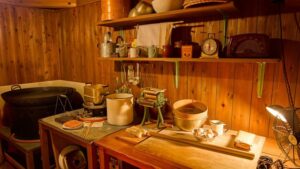
Instant Ramen was invented in this workshop by Ando Momofuku
The Invention of Instant Ramen

Osaka, Japan, January 6, 2007: A Hero of Our Time … In 2007, at the age of 96, Ando Momofuku, the inventor of Instant Ramen, passed away. While a student at Ritsumeikan University he learned to operate a clothing business, but on a cold night shortly after World War II, he came upon a long line of people who were waiting to buy fresh ramen (noodles) at a black-market food stall. In an epiphany, he came to believe that the world would have peace when people had enough to eat.

So in 1948 he began learning the food business, and ten years later developed instant Chicken Ramen, which he thought would provide better nutrition for soldiers in the field. His company grew and grew and grew. Two years ago, his company developed vacuum-packed noodles for Japanese astronaut Soichi Noguchi to eat on the U. S. space shuttle Discovery. When interviewed, Ando said, “I’m happy I’ve realized my dream that noodles can go into space.”

One small step for man, one giant leap for noodles. But perhaps more important is this: We don’t know who invented beans and rice, and we don’t know who invented spaghetti, but we do know who invented Instant Ramen. So for all the students of the world, and for those of us who once needed very affordable food for a simple meal, we thank you, Ando Momofuku.

In this simple way, you’ve changed the world.

Categories // All, honor, Looking Back, News

Adrienne’s Philosophy

03.13.2011 by bloggard // Leave a Comment

She says it’s this —

Eat when you’re hungry.
Sleep when you’re tired.
Drink water all day.
Make a living as best you can.
Be kind to others.
If you get to travel, it’s a blessing.

Now you know.

Categories // All, Looking Back

So Long — Robert Moog to Infinity

03.13.2011 by bloggard // Leave a Comment

Asheville, North Carolina, August 22, 2005: Robert Moog, 71, the inventor of the synthesizer, died today at his home, from an inoperable brain tumor. A childhood interest in the theremin
young bob builds the synthesizer led him to create sound modules, creating the first synthesizers used in early electronic recordings such as ‘The Nonesuch Guide to Electronic Music.’

Early recording artists such as Walter Carlos — later Wendy Carlos — and two musicians I met in a Los Angeles Warehouse, Paul Beaver and Bernie Krause — brought synthesized sound into the radio landscape, where it has become the background music for our lives today and into the future.

Despite hobnobbing with headliner musicians world-wide, Moog remained quite humble about his place in the world. For example … [Read more…]

Categories // All, Looking Back, music

The Bloggardian Credits

03.13.2011 by bloggard // Leave a Comment

“A Tiny History of Hurnville” — most of this information comes from a written manuscript left in family papers, dated 1959, and written by my grandfather, Frank Hurn.

“A Tiny History of Henrietta, Texas” — Aside from personal memories, the bulk of historical fact was, in proper scholarly fashion, stolen from the Handbook of Texas Online website. The historical summary there was written by Lisa C. Maxwell, who cites the Katherine Douthitt book “Romance and Dim Trails,” (1938), the St. Clair book “Little Towns of Texas,” (1982), and the William Taylor book “A History of Clay County,” (1972). Much additional information can be found in my Uncle Eugene Hurn’s book “A Pictoral History of Clay County,” which can be found in the Henrietta library, or through the Henrietta/Clay County Historical Society.

Law 23 regarding Being, Doing, and Having. I first encountered the interesting concepts of Be – Do – Have in the writings of L. Ron Hubbard, of Scientology fame, although I have since found them and their analogues in several other places. In Hubbard’s writings I also found the developed concept of ‘Havingness’ described in How to Pick Up Girls (Part 1).

Categories // All, Looking Back

Sponging at the Girl’s Dorm

03.13.2011 by bloggard // Leave a Comment

North Texas State University, Denton Texas, 1962: When several of us lived in a house in Shady Shores on Lake Dallas, there was kind of a “girl gang” who came to visit.

Jan was round and pretty, and she liked Hardy.

Jill was thin, clever, and funny, and I liked her.

Shayna was mature, beautiful, and she liked Paul, who was actually engaged to someone else, though that didn’t seem to interfere much.

They’d all show up at the lake house. We laughed a lot. I remember nights with a bonfire on the beach, a lot of beer. I remember driving to some dive up the road where, again, we drank a lot of beer. I grew sleepy and closed my eyes and pretended to be blind for a while.

“Come on, blind man!” Shayna said, “Stay with us!”

She was Jewish, daughter of a well-to-do Dallas family who owned a milk company. I didn’t know much about being Jewish and asked questions. She said they didn’t believe in the Devil, and so I asked if she would sell me her soul.

She said she would.

We wrote up a contract

So I bought her soul, for five pieces of silver, writing up the contract on my typewriter, an impressive red IBM Selectric I’d inherited from my stepfather’s office.

She took the five dimes and signed the contract. So I have owned Shayna’s soul for many, many years, because I kept the contract safe in my red box of important stuff.

The red box stayed with me through college, Dallas, St. Louis, England, Los Angeles, Texas, and San Francisco. There were a lot of documents in there, transcripts, and government cards, and drawings, and other stuff, including Shayna’s soul.

Meanwhile, back in those college times, I turned to crime

But this is getting ahead of myself. Back at North Texas, the next year I got a tiny apartment across from the English building, and I rarely saw the girl gang. There was always a blitz of study right before Christmas Holiday, and unlike my friends, often I didn’t go home right away, but rather stayed in my quiet apartment.

The campus was empty and thoughtful, the weather clear and chill. Restful, it was, though I had no money. One night I spent the last of my cash on cigarettes rather than supper, and in the morning, I woke up hungry.

Down on the corner in the early morning light, I saw the bread truck, parking to deliver to the Hob Nob. As the driver went inside, I crept from the bushes, jumped into the back of the truck, stole a loaf of bread, and ran.

As I glanced behind me, I saw Larry Burns, the young man who operated the Hob Nob, standing in the back doorway. He was watching me and laughing. Damn!

Pondering starvation

Holed up with coffee and bread and cigarettes, pondering starvation, I remembered that, during the holiday vacations, the cafeterias of all the dorms closed, except for one. The same dorm where the girl gang lived.

So I called on them about lunchtime, and then discovered that any dorm students stranded on campus over the holiday took meals there in the girls’ dorm. I walked into the dining room between Jill and Jan. Lunch!

Free lunch! Lots of lunch! Plenty! Free!

The cafeteria ladies, seeing so many unfamiliar faces, just assumed I lived in one of the dorms, and fed me along with everyone else.

I went back every day.

Ah, those good times …

That was the last time I saw the girl gang. Things happened, and you lose track.

And twenty years later, in a flat overlooking Geary Boulevard in San Francisco, where I lived in a small room at the back of Network Answering Service, I found Shayna’s soul stored carefully in the red box.

Through her family’s milk company in Dallas, I located her, married long since and living on the coast north of Los Angeles. I called her.

She didn’t remember that I owned her soul. She hadn’t missed it. We hadn’t much to talk about. Things had changed.

After the phone conversation, since I had her address, I mailed her soul back to her.

It was the least I could do.

Categories // adventure, All, college, friends, happiness, Looking Back, North Texas State University

Cowardice Won’t Work

03.13.2011 by bloggard // Leave a Comment

New York Times, August 22, 2004: Writer Stephen Johnson reports on an almond-shaped part of the brain called the amygdala (pronounced “uh MIG’ dulluh”), which is part of the primitive limbic system, which relates to emotions.

Do liberals ‘think’ with their emotions?

“Studies of stroke victims and scans of normal brains,” he reports, “have shown that the amygdala plays a key role in the creation of emotions like fear or empathy.”

If amygdala activity is a reliable indication of emotional response, it raises the interesting question: Do liberals ‘think’ with their limbic system (emotions) more than conservatives do?

And the answer appears to be: Yes, they do.

Not long ago, U.C.L.A. researchers analyzed neural activity of Republicans and Democrats viewing images from campaign ads. It turns out that ‘violent’ images — such as pictures of the 9/11 attack on New York’s World Trade Center towers — produce different effects in Republicans and Democrats.

In fact, you could predict which are the Democrats just by observing the brain scans, because the Democrats had much stronger activity in the amygdala region. Note that this is a reading on a ‘gut response’, operating below the person’s conscious control.

So we learn that liberal brains have generally more active amygdalas than conservative ones. So what?

It’s a plausible explanation that matches some of our stereotypes about liberal values:

* an aversion to human suffering
* an unwillingness to accept capital punishment
* an unwillingness to accept military force
* a fondness for candidates who like to feel our pain.

Which suggests how we may become Republicans or Democrats in the first place.

“Say you’re inclined to form strong emotional responses to images of violence or human suffering,” said the Times article, “and over the course of your formative years, most of the people you meet who respond to these images with comparable affect turn out to be Democrats. That’s a commonality of experience that exists beneath conscious political affiliation — it’s closer to a gut instinct than a rational choice — but if you meet enough Democrats who share that experience, sooner or later you start carrying the card yourself.”

Some of the pundits elsewhere were generalizing from these experiments to suggest that liberals would be more emotional and less rational, using “emotional thinking” more heavily, and that they would be generally more fearful. And that conservatives would tend to be more analytical and more courageous.

Last night, watching Vice-President Dick Cheney debating John Edwards, it seems to me that’s exactly what I saw. Cheney seemed to be more analytical and cited a “braver” course of finding and stomping terrorists around the world till it’s done. Attorney John Edwards seemed more like a car salesman, hitting on the emotional buttons, and glossing over inconsistencies of the past anti-war voting records of himself and Mr. Kerry.

I’m not a political expert, but with a fair amount of past experience in language de-construction and training in counseling and reading body language, I personally would trust Dick Cheney over John Edwards. I caught John Edwards in too many sophistic devices (trickery in using the language) to believe him very much.

I’ve also noticed two things in life.

One is that if you experience a friend or employee or anyone who’s attempting to ‘blackmail’ you, it never pays off to pay them off.

For example, your pal is using emotional blackmail like “If you don’t loan me this money, I’ll feel awful and it will be all your fault!” Or for example, your employee says “I need to have a raise immediately or I’ll quit.” In that case, no matter how awkward it is to let them quit, you’d better just let them quit. Because if you give a raise for this reason (instead of giving a raise because their work has earned one), they’ll just wait till another awkward time to spring the same ruse again. (I had this experience with a bookkeeper named Kathy. The first time I paid up. The second time I paid up. The third time I bid my fond adieus.)

As regards terrorists, if we follow Spain or the Philippines in a pattern of appeasement, we’ll just get more of the same. I’m no political analyst, but it seems like the USA did that very thing under Clinton, with no consequences for the bombing of the USS Cole, no consequences for the Oklahoma government building bombing, no consequences toward Saddam Hussein’s defiance of the United Nations. And we got more of the same. Just like Kathy, they’ll be back.

Till we kill them.

That takes courage. That takes guts.

I don’t like war. But even less do I like our kindergartens in Oklahoma being bombed by fertilizer-filled trucks, discos blown apart during bar mitzvas, dirty bombs in our cities, and seeing people leap from flaming skyscrapers to fall, and fall, and fall.

Some “humans” are not quite human. Some are still barbarians. Some will knife you in a ghetto for your sneakers. Some will bomb your children’s kindergarten and call it religion. They aren’t like me and you.

Being nice won’t work.

Pulling out of the war, on a certain date, won’t work.

This is a new face of war, and there are no Marquis of Queensbury Rules in a knifefight. The bad guys aren’t just the soldiers inside a certain country. You can’t just go there and they’ll come out and fight. Yet, to avoid barbarians murdering those we love, we must fight. And we have to go about fighting differently.

The second thing I’ve learned in life is that, if you must fight, what wins is the use of excessive force.

For example if you just block the incoming blows, sooner or later, you’ll miss and you’ll lose. This reminds me of President Bush debating Senator Kerry last week. Kerry continually attacked, and Bush continued defending against the attacks, and that’s not an effective way to win such a debate.

Similarly, once we have the fact that these subhumans called terrorists do intend to kill us and our children, it will not be enough to just block them. They won’t go away. In fact, our refusal to viciously fight will be interpreted by them as weakness, and will encourage them to escalate. In their eyes, we the enemy are running away and so it’s time to mow us down ha ha ha! Look at the funny bleeding infidels! Ha ha ha.

Empathy, a “more sensitive” war, holding “summits”, issuing “directives”, or “withdrawing in six months” — none of these are courageous. None of these will work.

Cowardice won’t work.

We may not like it, but we’re in it. Relentless effort on our part, unreasonable effort on our part, deadly effort on our part, toward terrorists and their allies like Mr. Hussein … that’s the only thing which will work.

Liberals, with gut-instinct aversion to war, too bad.

Fight or die.

Categories // All, consciousness, Looking Back, mind, non-conscious mind

  • « Previous Page
  • 1
  • …
  • 18
  • 19
  • 20
  • 21
  • 22
  • …
  • 37
  • Next Page »

Your Fortune Cookie

  • While people enjoy good music and food, a description of Tao seems formless, for it cannot be heard and cannot be seen. But when the music and food are all ended, the taste of the Tao still remains. -- Tao Te Ching

Our Host


Perhaps you are wondering why I have gathered all of you here.

Recent Posts

  • Getting Stronger, Seems Like
  • The Book of Hu
  • Mister Blue
  • Join Me on Social Media …

Recent Comments

  • bloggard on The Altar Boys
  • Tonja Scheer on The Altar Boys
  • Raymond J.Reiss on Calling Lonesome Cowboy Tim

Search By Keyword

Currently 605 micro-stories searchable online. Enter search words and hit return:

Search by Category

View My LinkedIn Profile

View Arthur Cronos's profile on LinkedIn

Credits and Copyright

All contents copyright (c) 2001-2026 Arthur Cronos and Voltos Industries, Mount Shasta, California. Reproduction prohibited except as noted. All rights reserved.

Webdesign by VOLTOS

** TEXT NAVIGATION **
Home * Archives * About the Bloggard * Bloggard's Concise Autoblography * Contact Us * Terms of Use * Privacy Policy * Site Map * Voltos Industries


reviews

[wprevpro_usetemplate tid=”1″]

All Contents Copyright © 2001-2019 · Webdesign by VOLTOS