
The Adventures of Bloggard

Been Around the Block. Got Some Stories. These are Them.

  • Home
  • Archives
  • About Bloggard
  • Concise Autoblography
  • Contact

Unexpected Visitor

03.13.2011 by bloggard // Leave a Comment

A plump British Robin Redbreast sitting on a snow frosted fence post

Mount Shasta, February 15, 2004: As I was sleepily rising, Adrienne called from the kitchen. The fat robin was in trouble.

In our back yard, near my office door, the holly tree sports bright green prickly leaves, and bright red berries. Mothers around the world have warned us as children: Don’t eat the berries! That’s why I believe, and you believe, that the berries are poison.

Our robins, however, have never been warned by their mothers, and appear to gobble the berries throughout the winter. And do the robins appear dead, lying feet up in the snow?

They do not.

But one of the robins, the big fat one — we marvel that he can even fly — is sitting in the snow, today. Adrienne had spotted him in the branches, sitting very still. She worried, when she went outside, that he didn’t fly away.

And now he’s on the ground.

He’s not dead, for he looks around at me as I peek from the chilly doorway. I diagnose the freezing cold, rather than the holly berries, as the problem. Luckily, as I picked up a dog towel from the floor, Adrienne gives me professional advice on towel size, and provides me with a smaller one.

On the porch as I crunch through the snow, I speak softly to the big fat robin, and he permits me to wrap the towel around his little body. As I return to the kitchen, this fine wrapped bird in hand worth two in the snowy bush, Adrienne jitters.

“Don’t bring him in here!” she cries. “Take him out in the garage … to warm up!” But I don’t think the garage is very warm. I’ve been in that garage.

“I wanted you to see him,” I said, but before she could come over to see, suddenly between my warm hands a wild flutter and the bird launches, from within the towel, scrabbling and flying at the ceiling, the doorway, then quick as lace around a corner into the living room’s tall roof and the windowsill ten feet above the floor.

There he perches upon the sill, and flutters at the glass, perches and flutters, perches and flutters.

I ponder. I ponder over a cup of coffee, then another coffee. I ponder over toast and peanut butter. Pondering becomes me, but Adrienne has become impatient.

“Go on,” she says.

I try the magic trick. Holding my arm up toward the bird, with one finger outstretched, I say, “Come land on my finger.” It worked once with a fly; maybe it will work now.

Nope. It doesn’t.

I fetch the ladder from the garage. I clatter through the doorway, and set up the ladder below the window.

Up I go.

My balance is not what it was, but, hey, I’m only four feet up, daring bird charmer I. I have my specialty bird towel, and I speak calmly to the fat robin. He’s a little excited. Probably doesn’t get so much company, so up close and personal, most of the time.

I wait.

Sure enough, his perch and flutter method first takes him to the far side of the sill, and then his perch and flutter method brings him near. I wrap the towel around him; he is caught. He goes still, wrapped secure in the towel.

Outside on the back porch, I unwrap him and attempt to place him on a branch, thinking perhaps we might have a conversation. But once free, like a bat out of hell, or perhaps more like a robin freed from monsters, away he speeds in a straight line, away to the west to the tall, tall, distant evergreens so safe and dark on the far side of the block.

Probably just now he’s telling robin buddies about his adventure and his escape. Probably they don’t believe him. Among the branches, in the chill they stomp their feet and hunker down, awaiting the warm weather to come again.

Soon the talk turns to more acceptable subjects such as eggs and nests and cute lady robins, and bugs to eat.


 

Categories // adventure, All, animals, buddhism, fantasy, Looking Back

Sweeping the Snow

03.13.2011 by bloggard // Leave a Comment

Seventeen Cars for the Rock Island!

St. Louis, Winter 1967: At the Carrie Street station are fourteen tracks, lined up beside the main tracks that run around town to the Southern Pacific, the Erie, and the other lines. A local company called the “Terminal Railroad” hauls cars on these main tracks, in a big circle around the city.

“Got seventeen Rocks!” the Terminal conductor says, walking into the concrete office where the bill clerk and I do our work. He hands a bundle of Bills of Lading wrapped round with a rubber band to the bill clerk, while outside Danny and the switchmen throw the switch levers sticking up from the tracks, so that the Terminal train, which has just passed our yard and is now stopped, can back up these seventeen cars for us, the Rock Island Line, into one of our fourteen tracks.

Unhitched, those seventeen cars sit while the Terminal locomotive powers the rest of their train around the bend and out of sight.

And then it began to snow.

I never knew exactly what Bill the bill clerk did, but he spent his time inside the concrete office. I’d spend my time standing outside in the cold while the cars rolled past, writing down the car numbers as fast as I could.

If I could write these numbers as the cars passed by, then I didn’t have to walk up and down the freezing tracks to write down the numbers. From my car numbers written down and in order, Bill the bill clerk prepared a list for Danny and the switchmen.

By analysing the Bills of Lading, Bill determined that some cars were going to Kansas City — the next stop beyond St. Louis on the Rock Island Line — and that some other cars were bound for Denver or Santa Fe or Oakland. It was my job then to carry Bill’s list across the yard to Danny the switch foreman, and Danny would figure how to move the cars around into the correct order, so that the last group dropped off at Kansas City, the next group in Denver, and so on.

An engineer would then hook the switch engine to the cars, and pull them all forward, and then push them back into this track, and that track, and this other track, because that’s how you sort railroad cars. Some cars were called “pigs” because their flat beds were to be loaded with truck trailers; it stood for “piggy-back”. Other cars were called “reefers” because they were insulated, with motors on top to keep the interior refrigerated; these would be filled with perishables like frozen orange juice, or lettuce. Some cars were “tankers”, and some were plain old boxcars.

During all this switching, the switchmen, under Danny’s direction, stood at the switches. A switch is a tall iron bar sticking up from the tracks; you push or pull on the switching bar so that a section of track moves a few inches, so as to guide the incoming cars into track number four or track number five.

While the switchmen sorted cars, I returned to my desk with a copy of the switching list Danny made up, and upon my desk into a big box containing slots, numbered the same as the tracks outside, I sorted the Bills of Lading into the same order as the switchmen were sorting the cars. These Bills of Lading, in order, would go to Kansas City with the cars.

You see how many guys it takes? You see how all the jobs are divided up? You’d think that, since Bill and I had periods of time with nothing to do, as did the switchmen, that we could double on each others’ jobs. But no!

The union has penalties for that behavior. All jobs are defined and regulated by the union. Only a switchman can throw a switch. Only a yard clerk (me) can write down the numbers and sort the bills. Our jobs were protected, see, and we paid our union dues to keep it that way.

The problem was that this particular Sunday it started snowing, and soon there was an inch of snow on the tracks and switchboxes.

Mind you, this doesn’t interfere with the switchbox at all. The switchbox is a foot-square metal box, containing the gears that move the track section. Remember, the long bar that operates the switchbox is sticking four feet up into the air above the switch box with its one inch of snow.

But according to union rules, the switchmen are not required to throw a switch which has snow upon it. Instead, the switchmen can retire to huddle around the coal stove in the switch shanty, to read newspapers, shoot the breeze, and generally do nothing for the same hourly pay.

As soon as somebody sweeps the snow off the switch — a matter of four or five seconds with an ordinary broom — then the switchmen have to go back to work, moving those pigs and reefers and tankers into place for their trip to Kansas City.

Now, the person whose job includes sweeping snow off a switch is a carman. The carmen work normal business hours in the shop down at the end of track three. That’s where they repair broken cars, replace wheels, adjust brakes, grease bearings, and such maintainance work.

On this Sunday afternoon, the carmen had all gone home.

It therefore fell to Bill the bill clerk to call a carman out to the job. Now, Bill knew that many of the carmen would turn the job down. In fact he was pretty sure that the first dozen on the list — a list arranged by seniority — would turn it down.

It would have saved time if Bill could have just called carman number twelve, but that’s not permitted, as the most senior guys must be offered the (overtime) job first. A number of hours were spent, with me and the switchmen sitting idle, and then with the Terminal railroad crew and their entire train sitting idle on the main track, just passing by but blocked by our now-immobile switch engine, which our engineer couldn’t move because the switch, which the switchmen weren’t required to throw, because there was snow on the switch.

During these hours only Bill was working, tracking down one and then another of the senior carmen so they could turn down the job, as was their right and privilege. Finally Bill reached the bottom of the list and James the carman said sure, I’ll be right out.

An hour later, when James hadn’t arrived, Bill called to discover that James had fallen back asleep, while our crews and hundreds of tons of merchandise sat immobile. James apologised and again claimed that he’d be right out.

An hour later, when James still hadn’t arrived, Bill suddenly swore aloud, and throwing his clipboard across the room, he threw on his coat, grabbed the broom, and stomped across the yard, where he swept the snow from the switch in three quick strokes. The switch crew came out of the shanty to stare at Bill. Bill glared at the lot of them.

“Now throw the damn switch!” he roared.

Muttering and swearing, the switchmen marched into the cold and back to work, and later that night, twelve hours late, our train departed for Kansas City.

James the carman never did show up, but he got one day’s pay anyway, because he’d been called out. Bill had a chit filed against him for “job endangerment.” And I gained a whole new way of looking at the union.

Categories // All, amazement, buddhism, Looking Back, zen

Basic Buddhism

03.13.2011 by bloggard // Leave a Comment

India, Long Ago: Gautama Siddhartha sat beneath the Bo tree, and stubbornly refused to rise until he’d reached enlightenment. (He’d tried many other things in that past.) One day, he reached enlightenment.
The enlightenment he attained permitted him to express the basic problem of living–which is how a person can gain freedom from suffering–and his realization is summarized in four points, which are called “The Four Noble Truths” …

  1.  Our experience of living often consists of suffering. For example, we experience suffering from losses, illness, hunger, and death. The suffering comes from our insistent mental reaction against the “bad” thing. That is, we insistently desire to have a thing that was lost, and so we experience suffering. (As an example, you throw away a piece of paper and it is lost but you do not suffer. But you lose the deed to your home and you insistently desire that the situation be different, and you suffer. But if you give away the deed to your home to your child, then you do not suffer.)
    .
  2.  The suffering comes from the “grasping desire” for the thing lost. It is demanding that “what is” be different, and then suffering because it is not different.
    .
  3.  And the answer? To eliminate your suffering, eliminate the grasping desire.
    .
  4.  To eliminate the grasping desire, follow eight important rules. In these rules (called the Eight-fold Path) are proscriptions against the things that often result in unhappiness (such as killing other folks), and prescriptions to engage in practices such as meditation, to learn to still the mind (and thus still grasping desire).

Want to Stop Suffering? Here’s How …

What this means in more modern language is that suffering comes from RESISTANCE to what is. For example, mentally *grasping* after something that you do not have right now. Or mentally *resisting* something that you don’t like. When you compulsively resist, you create–in your mind and in your experience of life–the thing we call suffering.

If you can relearn the mental habit of resisting what is, grasping after what you don’t have, and resisting things you dislike … the suffering in your life and mind fades away. Often immediately.

And remember, those troublesome mental habits are only habits, and habits can be changed. Presuming that (a) you *want* to change the habit, and (b) you’re willing to put in a little bit of practice.

Now, in truth, sometimes you can simply *decide* to let go and cease resistance.

But for most of us, years or decades of bad habits require us to put in a little effort, to *practice* the new way.

Even Shorter:

Want to stop suffering? If yes, then (a) adopt the basis (grasping causes suffering) as a working theory, (b) make an ongoing attempt to increase your skill at “letting go,” and (c) it helps if you learn how to allow your mind to go still, which helps a lot, and which we usually call “meditation.” The Buddhists describe your new understanding and your attempt at relearning as having “Right Mindfulness,” and it’s one item in the Eightfold Path mentioned above.

If you understand the cause and the cure (given here) … if you will attempt to change the grasping … then your suffering will fade away.

And it feels really, really good.

Get it? (Got it.) Good!


Categories // All, buddhism, enjoying life, Looking Back, making changes, meditation, personal growth, Problems, Wisdom Log, zen

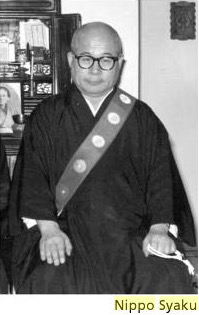
Bishop Nippo Syaku

03.13.2011 by bloggard // 1 Comment

San Francisco, 1975: I saw the flimsy poster, but it was quaint rather than crude. Bishop Nippo Syaku would give some short talks about Zen. In the rawboned Victorian near Filmore street, poor lighting made the room seem drab, but Bishop Nippo lit up the place. The Bishop was a round-faced, cheerful fellow, very chipper he was. He spoke often of the nature of things.”We say, ‘Oh the flower is pretty!’” He beamed, “But flower does not care!”

On this evening, he spoke of how the True Buddhist is without fear. This amazed me, and made me ponder. I raised my hand.

“Yes?”

“Let me see if I’ve got this straight,” I said. I pointed to an empty chair. “Let’s say the True Buddhist was sitting right there.”

Bishop Nippo nodded.

“And let’s say that a Sabre-Tooth Tiger came through that door.” Everybody looked at the door. I continued, “Now the True Buddhist would feel no fear, but he would jump up and run like hell, correct?”

“Ah!” said Bishop Nippo Syaku. “That is True Buddhist!”

Categories // All, buddhism, consciousness, happiness, ideas, Looking Back, meditation, mind, personal growth, zen

Your Fortune Cookie

  • Shinbone: the device for finding furniture in a dark room.

Our Host


Perhaps you are wondering why I have gathered all of you here.

Recent Posts

  • Mister Blue
  • How to Drop the Weight, Look Better, and Feel Better … Made Easier
  • Most-efficient Exercise for Strength, Longevity, Blood-Pressure, and Balance
  • Creatine – for Fixin’ Up Your Brain!

Recent Comments

  • bloggard on The Altar Boys
  • Tonja Scheer on The Altar Boys
  • Raymond J.Reiss on Calling Lonesome Cowboy Tim

Search By Keyword

Currently 602 micro-stories searchable online. Enter search words and hit return:

Search by Category

View My LinkedIn Profile

View Arthur Cronos's profile on LinkedIn

Credits and Copyright

All contents copyright (c) 2001-2026 Arthur Cronos and Voltos Industries, Mount Shasta, California. Reproduction prohibited except as noted. All rights reserved.

Webdesign by VOLTOS

** TEXT NAVIGATION **
Home * Archives * About the Bloggard * Bloggard's Concise Autoblography * Contact Us * Terms of Use * Privacy Policy * Site Map * Voltos Industries


reviews

[wprevpro_usetemplate tid=”1″]

All Contents Copyright © 2001-2019 · Webdesign by VOLTOS