
The Adventures of Bloggard

Been Around the Block. Got Some Stories. These are Them.

  • Home
  • Archives
  • About Bloggard
  • Concise Autoblography
  • Contact

A White Sport Coat, and Rocket Fuel

04.24.2011 by bloggard // 11 Comments

Henrietta, Texas, Easter Sunday, 1958: I have Easter finery, and it is a white sport coat. At age twelve, this seems especially neato to me, because that Marty Robbins song about the White Sport Coat and a Pink Carnation is still playing on the radio.

Usually, on school days, like my friends, I wear Levis or Lee Riders with a sport shirt. Because it is so cool to do so, I wear black loafers with white socks. Bobby Mitchell. has explained this to me, and he is a great fashion plate.

Bobby, Eddy Frank, Billy Ray, and several others are studying rocketry, and building rockets from aluminum tubes, hacksaws, wood, and gunpowder. Most of these rockets do not work, but we’re not giving up!

Today, however, I’m wearing Easter finery and sitting in my room, bored, because I’m dressed and ready for church, and the rest of my family is still getting dressed.

So that’s why I was fiddling with the rocket fuel.
[Read more…]

Categories // All, amazement, childhood, family, friends, Looking Back

Adrienne Searches on Google

03.13.2011 by bloggard // Leave a Comment

Weed, California, Spring 2009: Adrienne is still somewhat new to computers, and she comes up with things that often elude me.

(Even around the house; she fixed the ‘broken’ garbage disposal; I’d never have thought to use the plumber’s friend plunger!)

She has good results with the search engine, and uses it all the time.

One day I watched, and she types in entire sentences, like “Where can I find a list of all the major dog sanctuaries in the United States?”

I asked her why she didn’t just enter “dog sanctuaries”. [Read more…]

Categories // amazement, family, ideas, Looking Back, truth

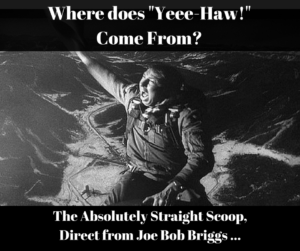
On This Day: Joe Bob Briggs Explains ‘Yee-HAW!’

03.13.2011 by bloggard // Leave a Comment

Mount Shasta, CA, December 31, 2006: Recently, when Adrienne was writing our Christmas cards, she asked me how to spell ‘Yee-HAW’. If you live in a foreign country and do not know, this is something that Texas people like to yell out; it connotes extreme enthusiasm. For example, in the movie Dr. Strangelove, when Slim Pickens rides the H-Bomb, he yells, “Yee-HAW! Yee-HAW! Yee-HAW!” This signifies his happiness in the moment.

Since Adrienne is from the East Coast, she didn’t know how to spell it, and so I told her. But that got me to thinking …

Where did Yee-HAW come from?

Where did ‘Yee-HAW’ come from? What is its origin? Did it come down to us through the ages, or was it just something that some cowboy yelled out one day while riding a wild horse, and somehow it caught on?

Naturally, these questions made me think of Joe Bob Briggs — the best drive-in movie reviewer in the greater Grapevine, Texas area — who is a veritable font of crucial information that we sorely need in these troubled times. If anybody would know, I reasoned, it would be Joe Bob Briggs, who is a close personal friend of mine. So I asked him.

Here is his answer …

“Yee-Haw derives from the Middle English “yee,” which became “ye” by the time of the King James Bible, a formal second-person pronoun normally used only in the singular but occasionally, when conjoined with qualifiers (“ye ungodly swine”), acceptable as an adjectival plural as part of an interjection.

“The word “Haw” was a borrowing from late 10th century Hungarian, a crude epithet used by soldiers to describe a rural imbecile (possibly a distant cousin of “harrow” or “harrower,” applied to those who till the soil, who were overwhelmingly illiterate in the Middle Ages).

“The words “yee” and “haw” were never used together until 1478, when a farrier in Long Sutton, among the eastern fens of Lincolnshire, was accosted by angry sugarbeet farmers whose draft animals had been quarantined by the Duke of Rutland upon pain of taxation necessary for the upkeep of Belvoir Castle. To defend himself from the angry mob, he quickly extracted iron bits from his furnace with a blacksmithing tong and hurled the fiery missiles at the luckless yeomen.

“When they began to scatter, the farrier execrated them with curses, including, at the point of his maximum excitement, “Yeeeeeeee Haaaaaaaawwww!” — the strict meaning of which would be something on the order of “you worthless lice-infested buffoons,” but of course given a sanguine connotation by the fact that the farrier was exultant and triumphant.”

“I thought everyone knew that.” — Joe Bob Briggs, www.joebobbriggs.com

Thank you, Joe Bob. As this year winds down, as a prediction for the new year coming in, I would add only this —

Yee-HAW!

Categories // All, amazement, friends, fun, Looking Back, opinions, quotes

So Long — How James Brown Wrote Those Songs

03.13.2011 by bloggard // 1 Comment

Cabana Hotel, Dallas, 1966: Sometimes I was a desk clerk, and twice a week I filled in for the night auditor. This is the cashier who works the midnight shift and balances the day’s charges for the rooms and restaurants and the bars in the hotel.

The Godfather of SoulIt was a fancy hotel. Sometimes famous people stayed there. This particular night it was James Brown and his entire band, the Famous Flames. He came strutting through the lobby, looking just like he was ‘spozed to. No cape tonight. Disappeared into the elevators.

Later, lounging on the huge round sofa in the lobby, I had the opportunity to talk with a couple of the band members, who were relaxing after the gig.

“How does he write those songs?” I asked.

They told me.

James Brown had a system. It went like this —

First they’d rent a recording studio. Mr. Brown would have just the drummer and the bass player mess around until he heard a groove he liked. Then he’d ask them to lock in that groove.

Then they’d build up from the bass groove, just going up the frequency range. They’d add rhythm guitar atop the groove, and then Brown’s voice atop the rhythm guitar. And last they’d lay the high-pitched horns onto the very top. Listen to one of the songs; you’ll hear it.

He would mess with the rhythms and the harmonies, until he thought maybe they’d got it right.

But then, the test. It worked like this. They’d open the back door of the studio, and recruit a half-dozen kids age five to eleven, and they’d bring these kids into the studio. They gave the kids a dollar to “stand right there.” Then James Brown and the Famous Flames played the song.

If the kids, all on their own, started dancing, the song had made it. It would be recorded.

Apparently, every James Brown song you ever heard … made the kids dance.

What wonder then that it made us all want to dance? Because we are all kids.

Dying this week from pneumonia and congestive heart failure, in Augusta, Georgia at age 73, the Godfather of Soul is gone. Our world remains the richer for his time here. Whose life doesn’t have the flavor and the rhythm this man brought into our world?

Makes ya want to … break out … in a … cold sweat!

Hunh!

Categories // All, amazement, Looking Back, music

Paddling Upon the Azure Lake

03.13.2011 by bloggard // 3 Comments

Lake Berryessa in Napa, California

Lake Berryessa, Napa County, CA, Summer 1973: My cousin Bruce was a video wizard, and he lived in Berkeley. (This was some years later than the time he pulled the plastic bra off the 30-foot tall woman in San Francisco.)

He invited me and Barbara A, the writer, to go a-boating. This was because he had a new boat. Well, sort of a boat. It was a yellow inflatable boat, and he was eager to take it for a sail upon the nearest lake.

Barbara A. and I foolishly agreed to go.

Bruce and Leanna brought their young son, Nathan. The boy was a bit obstreperous, but then so was Bruce. (And, truth to tell, me too.)

So the trip in the car seemed eternal.

This may have been due to our supply of green cigarettes. All things considered, considering the confusion, cross-conversation, maps, questions, squabbling, and wrong turns, it is miraculous that we found the lake at all.

And When We Got There …

The lake, eventually, turned out not to be one of those wooded alpine beauties tucked quietly among the hills. Rather, it was a man-made long blue swatch lying among brown summer hills out in a vast nowhere somewhere east of the city of Napa. All the same, it was a big stretch of quiet blue water, and we lugged the boat down to a bit of deserted shoreline. Then we lugged the boat back up to the car, and with a motorized gadget plugged into the green cigarette lighter, we pumped it up.

And then we carried the inflated boat down to the water and set it upon the lake.

We piled it with oars and a picnic basket. The two women climbed in. Little Nathan scrambled in. Bruce and I got in.

Then, because the boat was sitting on the bottom, Bruce and I got out and we eased the boat to deeper water and clambered in again to take up our oars.

We Set Off …

We paddled out a bit, and enjoyed the blue water around us, as we sat under the broiling sun. Somehow it now seemed that going over to a stretch of trees along the far shore might be a good idea, cooler for our picnic. This decision was long and involved, and somewhat difficult, but finally all were agreed: we would paddle to the trees and have our picnic.

I sat in one end of the boat, with Barbara near me. I could hear Bruce and Leanna and Nathan talking and squabbling behind us. I paddled.

And I paddled.

And I paddled.

It was hot, but I kept on paddling.

And paddling.

A Peculiar Situation …

But the odd thing, I slowly realized, was that we seemed to be making no headway at all, even though I was paddling and paddling and paddling.

Barbara and I discussed this, as I paddled, and after a bit of discussion and comparison of certain trees and rocks, she agreed: we were making no headway.

Calling out to Bruce behind us, we got him and Leanna to consider the phenomenon. They couldn’t quite agree whether we were making headway or not. Bruce was cussing in between paddle strokes, and I’d become tired of trying to follow their conversation, and I quit paddling.

The Mystery … Solved

Suddenly I noticed that the boat now seemed to be going backward!

Turning around, and looking at Bruce’s back, and him still paddling, I found the mystery was solved.

The two of us were paddling in opposite directions.

Categories // adventure, All, amazement, family, Looking Back, unconscious

Ozymandias

03.13.2011 by bloggard // Leave a Comment

Tomb of Ozymandias

I met a traveler from an antique land
Who said: Two vast and trunkless legs of stone
Stand in the desert. Near them, on the sand,
Half sunk, a shattered visage lies, whose frown,
And wrinkled lip, and sneer of cold command,
Tell that its sculptor well those passions read,
Which yet survive, stamped on these lifeless things,
The hand that mocked them, and the heart that fed,
And on the pedestal these words appear:
“My name is Ozymandias, King of Kings:
Look upon my works, ye Mighty, and despair!”
Nothing beside remains. Round the decay
Of that colossal wreck, boundless and bare
The lone and level sands stretch far away.

— Percy Bysshe Shelley

Henrietta, Texas, Spring 1962: As seniors, when the fresh air of Spring energized our blood, our thoughts turned lightly to painting our name on the town’s water tower, as is proper.

The culprits were the usual suspects, that is, Eddy Frank, David Gee, Billy Eugene, myself, and as I recall, also Donny Burkman, and Billy Ray. Two cars of us, so we parked in the next block so as not to arouse suspicion.

Earlier in the day, at Moore’s Hardware I’d found a spray can with paint of a delightful orange color. “King George,” I muttered to myself, “will be able to read that without his spectacles.”

We’d driven around first. In theory this was to see where the town cop was. In actual fact, we’d mostly sat in our cars in the bright lights of the Lo’ Boy Drive In, where we drank cokes. However, the cop did drive by, heading out on Highway 287. He’d probably turn around in a mile or so, but that was our chance, so we peeled out from the drive in and sped to the north of town, and parking in the next block, we eased our quiet selves through the darkness, as stealthy as buffaloes.

The water tower sat on a city block all by itself, on a huge bare lot. No fence, just grass and weeds. In the dark, looking up, it looked much larger. And much higher.

“Well,” said mild-mannered Billy Eugene, “Let’s go.”

“Pretty tall,” said David Gee.

“It certainly is tall. Yes it sure is,” said Donny Burkman.

“Well,” said Billy Eugene, “Let’s go.”

So we did.

On the south side, the metal ladder ended some distance from the ground, but with a leg-up from David Gee, and a bit of scramble, up we went, in single file. At first it wasn’t so bad. Kind of neat. You could see over the roofs of the houses! Things looked completely different.

About halfway up, it seemed … not quite so fun.

Looking up, past the boys ahead, the top seemed far away. Looking down, past the boys below, the ground seemed even farther. What if the ladder is weak? What if it came loose? What if Eddy Frank fell on me? What if …

But there was nothing to do, except to keep climbing. The spray can of paint, stuck in my belt, was poking my stomach. My hands began to ache. I whined to myself quietly.

But in a while, the top grew nearer, then close, and then some boys were over the edge onto the catwalk. I came to the edge and carefully clambered onto the catwalk, with hands grabbing my arms and belt. “Whoa!” I said.

The metal catwalk ran around the cylinder of the water tower, with a three-foot rail attached. With any sense at all, a person wouldn’t fall off the catwalk. I said this to myself several times. “Hang onto the rail,” said Billy Eugene. He was normally far less an outlaw than the rest of us, but perhaps this was just his type of crime.

About then, someone spotted the cop car coming up the road, and we all scuttled around to the far side of the tower. There in the dark we hid till he’d passed by. We knew that he’d likely continue north, past the last few houses and past the rodeo grounds, past Petticoat Hill, and past the reservoir, before turning around. “We’ve got ten or twelve minutes,” said Billy Eugene.

So we got busy.

Arraying ourselves on the two sides of the tower most visible from the main road, we began our work. Oddly, nobody had given much thought to what to paint. “Seniors of 62!” someone yelled. “Seniors of 1962!” I cried.

I popped the top from the spray can, held onto the rail behind me, aimed the can, and pressed the button.

A cold spray covered my nose and chin.

Oops.

In the dark, I peered to see which direction the spray thing pointed, but couldn’t see a thing. I turned the can about half way, tried again, got it sideways and felt the cool spray going off the the right. “Jesus, watch out!” someone growled. I tried turning the can, felt it slippery, felt it slip and spin, heard it clatter and roll, and then a long silence. It was gone.

OK, then. That went pretty well.

In the meantime, other boys had better luck, and it was time to skedaddle.

Carefully we circled to the ladder, and with lots of helping hands getting in the way, each of us climbed over the lip of the catwalk onto the ladder, and in hasty caution, climbed down the ladder, in a stifled horror that any minute the cop could show up with his searchlight.

But he didn’t, and we skulked through the darkness, climbed into cars, and made our getaway. They’d never catch us now, we laughed. Then the others caught sight of my chin.

Haw haw haw haw haw!

I peered into the mirror, and saw in the shifting light of the passing streetlights that my chin was now a bright orange. After riotous laughter at my expense, the others soon became concerned. This orange paint was a definite clue. And my chin was kind of a liability. “You got to clean that off,” said Billy Eugene. “We’ll go to Mitchell’s.”

Mitchell’s Truck Stop, out at the west edge of town, sold gas throughout the night, had bunks and showers for truckers, and ran an all-night cafe. There, after a Saturday Night date, after you’d taken your girl home, you were supposed to go to Mitchell’s Cafe and order Chicken Fried Steak. I know I did. It was always the perfect ending for a perfect evening. It was the spot to be.

Now just in case you ever find yourself at Mitchell’s Truck Stop Cafe, let me make a suggestion: Order the Chicken Fried Steak. You will first receive a bowl of salad, consisting of iceberg lettuce and tomato wedges, and an orange squeeze container. This is garlicky French dressing. Then you’ll get a plate with chicken fried steak, covered with white cream gravy splashed over french fries, and a red squeeze container of ketchup. Squeeze both ketchup and more French dressing over the gravy. Now you’re set. Man oh man!

However, on that night, for the first time, I headed for the gas station instead of the cafe. For the first time, I saw the bathroom in the gas station. Smelled it, too. Whoah!

I tried to wash off the orange paint with soap and water. No good. That was real good orange paint. The night attendant looked at me oddly, but found me some Ajax cleanser. There, with paper towels from the dispenser, water, and generous doses of the abrasive cleanser, I scrubbed and scrubbed and scrubbed. And scrubbed. And scrubbed.

My face grew redder and redder, and began to burn, but the orange paint finally showed signs of giving up the battle. After another twenty minutes of painful scrubbing, I resembled a burn victim, but my skin was merely red, not orange.

Now that my fellow criminals no longer feared my being seen, they were in an expansive mood.

“Wanna get some Chicken Fried Steak?” asked Billy Eugene.

This sounded swell.

Next door we trooped, and filled the great big round booth in the corner, and ordered up, laughing and recounting our adventure. The food, when it came, was somehow even better than on other nights. The perfect ending to a perfect evening.

We thought about tomorrow, and how people driving by the north road would look up. They’d see “Seniors of 62” and “Seniors 1962” painted in big letters. Haw haw haw haw haw!

We had made our mark.

Forever.

Categories // adventure, All, amazement, friends, Looking Back

That Big Bang Sound

03.13.2011 by bloggard // Leave a Comment

What did the Big Bang Sound Like?

13.7 Billion Years Ago: Bang!

Or was it? That is, what did it sound like, really?

Recently, an 11-year-old boy asked physicist John Cramer this question. And to answer the question, Cramer, working at the University of Washington in Seattle, has made a sound file so that you can hear the Big Bang for yourself.

Here’s how:

NASA runs a project called the Wilkinson Microwave Anisotropy Probe. Anisotropy means that something’s different when you measure it in two different directions. Who needs a word like that? Not something you can use every day, no.

Anyway, this microwave probe measures the temperature of the microwave light in the universe, in teeny-weeny little increments, like a billionth of a degree. During the Big Bang, the universe is thought to have been filled with very hot gas, and lots of light. Gas cools as it expands — that’s why hairspray or WD-40 feels cool when you spray it — so as the universe expanded, the gas cooled down.

But, aside from some condensation into suns and planets, the same gas still fills our universe, only it’s really thinned out and cooled down. The same light has travelled a long way, but it’s still around, too.

The Oldest Light in the Universe

By measuring microwave light in teeny-weeny increments, in all directions, scientists have made this picture of the oldest light in the universe (kind of like taking a picture of an 80-year-old man which shows him as an infant).

And from these same measurements, John Cramer calculated the frequencies of the sound waves moving outward through the first 760,000 years of our universe, when it was only 18 million light-years from one side to the other.

These sounds waves are such low frequency that we couldn’t hear them, so Carter has sped them up 100,000 billion billion times, to move them into the narrow range our ears can hear.

Now we can hear from the loudness and pitch what happened in the early universe. You’ll hear the frequencies fall during the recording because the sound waves become stretched as the universe expanded.

And now, for your listening pleasure:


The Sound of the Big Bang

Categories // All, amazement, Looking Back

Sweeping the Snow

03.13.2011 by bloggard // Leave a Comment

Seventeen Cars for the Rock Island!

St. Louis, Winter 1967: At the Carrie Street station are fourteen tracks, lined up beside the main tracks that run around town to the Southern Pacific, the Erie, and the other lines. A local company called the “Terminal Railroad” hauls cars on these main tracks, in a big circle around the city.

“Got seventeen Rocks!” the Terminal conductor says, walking into the concrete office where the bill clerk and I do our work. He hands a bundle of Bills of Lading wrapped round with a rubber band to the bill clerk, while outside Danny and the switchmen throw the switch levers sticking up from the tracks, so that the Terminal train, which has just passed our yard and is now stopped, can back up these seventeen cars for us, the Rock Island Line, into one of our fourteen tracks.

Unhitched, those seventeen cars sit while the Terminal locomotive powers the rest of their train around the bend and out of sight.

And then it began to snow.

I never knew exactly what Bill the bill clerk did, but he spent his time inside the concrete office. I’d spend my time standing outside in the cold while the cars rolled past, writing down the car numbers as fast as I could.

If I could write these numbers as the cars passed by, then I didn’t have to walk up and down the freezing tracks to write down the numbers. From my car numbers written down and in order, Bill the bill clerk prepared a list for Danny and the switchmen.

By analysing the Bills of Lading, Bill determined that some cars were going to Kansas City — the next stop beyond St. Louis on the Rock Island Line — and that some other cars were bound for Denver or Santa Fe or Oakland. It was my job then to carry Bill’s list across the yard to Danny the switch foreman, and Danny would figure how to move the cars around into the correct order, so that the last group dropped off at Kansas City, the next group in Denver, and so on.

An engineer would then hook the switch engine to the cars, and pull them all forward, and then push them back into this track, and that track, and this other track, because that’s how you sort railroad cars. Some cars were called “pigs” because their flat beds were to be loaded with truck trailers; it stood for “piggy-back”. Other cars were called “reefers” because they were insulated, with motors on top to keep the interior refrigerated; these would be filled with perishables like frozen orange juice, or lettuce. Some cars were “tankers”, and some were plain old boxcars.

During all this switching, the switchmen, under Danny’s direction, stood at the switches. A switch is a tall iron bar sticking up from the tracks; you push or pull on the switching bar so that a section of track moves a few inches, so as to guide the incoming cars into track number four or track number five.

While the switchmen sorted cars, I returned to my desk with a copy of the switching list Danny made up, and upon my desk into a big box containing slots, numbered the same as the tracks outside, I sorted the Bills of Lading into the same order as the switchmen were sorting the cars. These Bills of Lading, in order, would go to Kansas City with the cars.

You see how many guys it takes? You see how all the jobs are divided up? You’d think that, since Bill and I had periods of time with nothing to do, as did the switchmen, that we could double on each others’ jobs. But no!

The union has penalties for that behavior. All jobs are defined and regulated by the union. Only a switchman can throw a switch. Only a yard clerk (me) can write down the numbers and sort the bills. Our jobs were protected, see, and we paid our union dues to keep it that way.

The problem was that this particular Sunday it started snowing, and soon there was an inch of snow on the tracks and switchboxes.

Mind you, this doesn’t interfere with the switchbox at all. The switchbox is a foot-square metal box, containing the gears that move the track section. Remember, the long bar that operates the switchbox is sticking four feet up into the air above the switch box with its one inch of snow.

But according to union rules, the switchmen are not required to throw a switch which has snow upon it. Instead, the switchmen can retire to huddle around the coal stove in the switch shanty, to read newspapers, shoot the breeze, and generally do nothing for the same hourly pay.

As soon as somebody sweeps the snow off the switch — a matter of four or five seconds with an ordinary broom — then the switchmen have to go back to work, moving those pigs and reefers and tankers into place for their trip to Kansas City.

Now, the person whose job includes sweeping snow off a switch is a carman. The carmen work normal business hours in the shop down at the end of track three. That’s where they repair broken cars, replace wheels, adjust brakes, grease bearings, and such maintainance work.

On this Sunday afternoon, the carmen had all gone home.

It therefore fell to Bill the bill clerk to call a carman out to the job. Now, Bill knew that many of the carmen would turn the job down. In fact he was pretty sure that the first dozen on the list — a list arranged by seniority — would turn it down.

It would have saved time if Bill could have just called carman number twelve, but that’s not permitted, as the most senior guys must be offered the (overtime) job first. A number of hours were spent, with me and the switchmen sitting idle, and then with the Terminal railroad crew and their entire train sitting idle on the main track, just passing by but blocked by our now-immobile switch engine, which our engineer couldn’t move because the switch, which the switchmen weren’t required to throw, because there was snow on the switch.

During these hours only Bill was working, tracking down one and then another of the senior carmen so they could turn down the job, as was their right and privilege. Finally Bill reached the bottom of the list and James the carman said sure, I’ll be right out.

An hour later, when James hadn’t arrived, Bill called to discover that James had fallen back asleep, while our crews and hundreds of tons of merchandise sat immobile. James apologised and again claimed that he’d be right out.

An hour later, when James still hadn’t arrived, Bill suddenly swore aloud, and throwing his clipboard across the room, he threw on his coat, grabbed the broom, and stomped across the yard, where he swept the snow from the switch in three quick strokes. The switch crew came out of the shanty to stare at Bill. Bill glared at the lot of them.

“Now throw the damn switch!” he roared.

Muttering and swearing, the switchmen marched into the cold and back to work, and later that night, twelve hours late, our train departed for Kansas City.

James the carman never did show up, but he got one day’s pay anyway, because he’d been called out. Bill had a chit filed against him for “job endangerment.” And I gained a whole new way of looking at the union.

Categories // All, amazement, buddhism, Looking Back, zen

  • « Previous Page
  • 1
  • 2
  • 3
  • 4
  • 5
  • 6
  • Next Page »

Your Fortune Cookie

  • If you enter into a personal attack on your opponent, the chance of you losing the argument dramatically increases. -- Richard Butler

Our Host


Perhaps you are wondering why I have gathered all of you here.

Recent Posts

  • Mister Blue
  • Join Me on Social Media …
  • How to Drop the Weight, Look Better, and Feel Better … Made Easier
  • Most-efficient Exercise for Strength, Longevity, Blood-Pressure, and Balance

Recent Comments

  • bloggard on The Altar Boys
  • Tonja Scheer on The Altar Boys
  • Raymond J.Reiss on Calling Lonesome Cowboy Tim

Search By Keyword

Currently 603 micro-stories searchable online. Enter search words and hit return:

Search by Category

View My LinkedIn Profile

View Arthur Cronos's profile on LinkedIn

Credits and Copyright

All contents copyright (c) 2001-2026 Arthur Cronos and Voltos Industries, Mount Shasta, California. Reproduction prohibited except as noted. All rights reserved.

Webdesign by VOLTOS

** TEXT NAVIGATION **
Home * Archives * About the Bloggard * Bloggard's Concise Autoblography * Contact Us * Terms of Use * Privacy Policy * Site Map * Voltos Industries


reviews

[wprevpro_usetemplate tid=”1″]

All Contents Copyright © 2001-2019 · Webdesign by VOLTOS