The Adventures of Bloggard

Been Around the Block. Got Some Stories. These are Them.

  • Home
  • Archives
  • About Bloggard
  • Concise Autoblography
  • Contact

So Long — How James Brown Wrote Those Songs

03.13.2011 by bloggard // 1 Comment

Cabana Hotel, Dallas, 1966: Sometimes I was a desk clerk, and twice a week I filled in for the night auditor. This is the cashier who works the midnight shift and balances the day’s charges for the rooms and restaurants and the bars in the hotel.

The Godfather of SoulIt was a fancy hotel. Sometimes famous people stayed there. This particular night it was James Brown and his entire band, the Famous Flames. He came strutting through the lobby, looking just like he was ‘spozed to. No cape tonight. Disappeared into the elevators.

Later, lounging on the huge round sofa in the lobby, I had the opportunity to talk with a couple of the band members, who were relaxing after the gig.

“How does he write those songs?” I asked.

They told me.

James Brown had a system. It went like this —

First they’d rent a recording studio. Mr. Brown would have just the drummer and the bass player mess around until he heard a groove he liked. Then he’d ask them to lock in that groove.

Then they’d build up from the bass groove, just going up the frequency range. They’d add rhythm guitar atop the groove, and then Brown’s voice atop the rhythm guitar. And last they’d lay the high-pitched horns onto the very top. Listen to one of the songs; you’ll hear it.

He would mess with the rhythms and the harmonies, until he thought maybe they’d got it right.

But then, the test. It worked like this. They’d open the back door of the studio, and recruit a half-dozen kids age five to eleven, and they’d bring these kids into the studio. They gave the kids a dollar to “stand right there.” Then James Brown and the Famous Flames played the song.

If the kids, all on their own, started dancing, the song had made it. It would be recorded.

Apparently, every James Brown song you ever heard … made the kids dance.

What wonder then that it made us all want to dance? Because we are all kids.

Dying this week from pneumonia and congestive heart failure, in Augusta, Georgia at age 73, the Godfather of Soul is gone. Our world remains the richer for his time here. Whose life doesn’t have the flavor and the rhythm this man brought into our world?

Makes ya want to … break out … in a … cold sweat!

Hunh!
Categories // All, amazement, Looking Back, music

Ruru the Guru — Success at Last!

03.13.2011 by bloggard // Leave a Comment

San Francisco Yellow Pages, 1986: In the Yellow Pages that year you’d find listed “Third Ear Telepathic Answering Service” at 221-3333. If you called it you might hear this —

“Hello and thank you for calling Third Ear Telepathic Answering Service, the world’s favorite telepathic answering service. I am your Host and Operator Ruru the Guru, speaking to you direct from the Himalaya Hideaway …”

And today, May 5th of 2005, we have just obtained an excited interview with Ruru the Guru, whom we telepathed earlier today. Here’s what he had to say …

“Hello, sports fans, and a big Hmmm-baby! from the Astral Plane. I am so psyched!

“Probably you’re wondering what can get me so excital, what with being a 5th-level spirit and all, and having observed just about all of human evolution on most of the planets in this quadrant. But, I’m telling you, this is something!

“Many of you probably remember the many times, when you were feeling kind of, you know, discouraged, because your wife ran off or you didn’t get the big raise or your dog bit you? And you know how, lots of those times, you heard a little voice speaking quietly there in the back of your mind?

“And you remember how that little voice said something like how if at first you don’t succeed, then to try, try again?

“(Though, to be painfully honest, as we try to be here in the Himalaya Hideaway, of course there were other times when that little voice to heck with it and why not go get a beer.)

“Well, anyway, what I want to tell you is that, lots of those times when you heard that little voice telling you if at first you don’t succeed? Well, that was me, with a telepathic message which was sent from somebody that cares about you, most likely.

“And now, here we are in the year 2005, and it looks like what goes around also comes around!

“It looks like karma done come home to roost!

“What I’m telling you is that, all those years ago, back in San Francisco, when we paid good money month after month to run that yellow-page ad that said to call Third-Ear Telepathic Answering Service … well, today, for the first time ever … we got a telephone call. I swear to Krisna!

“And it was some attorney, off in Kentucky, calling us to inquire about buying telephone service from us!

“I mean, here it is, hardly even nineteen years after we ran that ad, and it’s still getting results! And, finally, a paying customer!

“So there you have it. Proof positive!

“Don’t ever let anybody tell you that yellow-page advertising doesn’t work!”

Categories // All, fun, Looking Back, ruru the guru

On This Day: Joe Bob Briggs Explains ‘Yee-HAW!’

03.13.2011 by bloggard // Leave a Comment

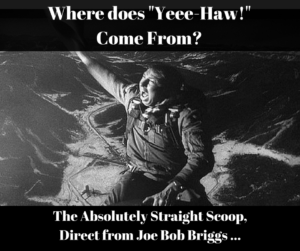
Mount Shasta, CA, December 31, 2006: Recently, when Adrienne was writing our Christmas cards, she asked me how to spell ‘Yee-HAW’. If you live in a foreign country and do not know, this is something that Texas people like to yell out; it connotes extreme enthusiasm. For example, in the movie Dr. Strangelove, when Slim Pickens rides the H-Bomb, he yells, “Yee-HAW! Yee-HAW! Yee-HAW!” This signifies his happiness in the moment.

Since Adrienne is from the East Coast, she didn’t know how to spell it, and so I told her. But that got me to thinking …

Where did Yee-HAW come from?

Where did ‘Yee-HAW’ come from? What is its origin? Did it come down to us through the ages, or was it just something that some cowboy yelled out one day while riding a wild horse, and somehow it caught on?

Naturally, these questions made me think of Joe Bob Briggs — the best drive-in movie reviewer in the greater Grapevine, Texas area — who is a veritable font of crucial information that we sorely need in these troubled times. If anybody would know, I reasoned, it would be Joe Bob Briggs, who is a close personal friend of mine. So I asked him.

Here is his answer …

“Yee-Haw derives from the Middle English “yee,” which became “ye” by the time of the King James Bible, a formal second-person pronoun normally used only in the singular but occasionally, when conjoined with qualifiers (“ye ungodly swine”), acceptable as an adjectival plural as part of an interjection.

“The word “Haw” was a borrowing from late 10th century Hungarian, a crude epithet used by soldiers to describe a rural imbecile (possibly a distant cousin of “harrow” or “harrower,” applied to those who till the soil, who were overwhelmingly illiterate in the Middle Ages).

“The words “yee” and “haw” were never used together until 1478, when a farrier in Long Sutton, among the eastern fens of Lincolnshire, was accosted by angry sugarbeet farmers whose draft animals had been quarantined by the Duke of Rutland upon pain of taxation necessary for the upkeep of Belvoir Castle. To defend himself from the angry mob, he quickly extracted iron bits from his furnace with a blacksmithing tong and hurled the fiery missiles at the luckless yeomen.

“When they began to scatter, the farrier execrated them with curses, including, at the point of his maximum excitement, “Yeeeeeeee Haaaaaaaawwww!” — the strict meaning of which would be something on the order of “you worthless lice-infested buffoons,” but of course given a sanguine connotation by the fact that the farrier was exultant and triumphant.”

“I thought everyone knew that.” — Joe Bob Briggs, www.joebobbriggs.com

Thank you, Joe Bob. As this year winds down, as a prediction for the new year coming in, I would add only this —

Yee-HAW!

Categories // All, amazement, friends, fun, Looking Back, opinions, quotes

My Rosicrucian Adventure

03.13.2011 by bloggard // Leave a Comment

Henrietta, Texas, August 1955: In a magazine, I’d seen the advertisement for the Rosicrucians. Being eleven, I was uncertain what a Rosicrucian might be, but they did promise to provide the Secrets of the Universe. That sounded pretty handy, so I sent off for free information.
 Information. Free.
 When the free information came, I was clear that it was free, though somewhat less clear just what the information might be. It looked very mystical, and had old and mysterious drawings of wise looking fellows and words in a wierdo alphabet, and astrological signs and odd chemical equipment. It seemed important.

I just wasn’t sure how. Or what it all meant. Or what to do, exactly.

However, my cousins were younger, and so I figured that however little I knew, they knew less.

From this august beginning came “The Mystical Order of the Golden Dagger”.

Being summer and no school, I had plenty of time for the Golden Dagger itself, which I carved with my pocket knife. It was actually more of an Arabian scimitar, which I had seen in my Viewmaster slide about Aladdin and the Magic Carpet. No problem. And of course, I had some paints left over from a ‘painting kit’ which had failed to help me generate anything faintly resembling Van Gough or Talouse Latrec or Guy d’Maupassant.

For theThe Golden Dagger (and a hat) actual Golden Dagger, gold paint was missing, but yellow worked OK.

Then of course we would need a fancy altar with mystical symbols, and a handy wooden orange crate with legs added worked fine for that. There may have been some other mystical things in there, but I don’t remember now.

On a weekend at my grandparent’s farm, I was able to copy the greek alphabet from the back of a large dictionary they had, and also some electrical-wiring symbols. That was fairly mystical. And then I bundled the whole shebang down into the (generally unused) potato cellar which was in the chicken yard. It being dark, and similar to a cave, a person could burn mystical candles and whatnot, there in the potato celler. Oops, I mean the mystical cave.

When I next saw my cousins, Bob and Dan, I was all set.

First, they were made to understand that we had a very important secret society, and they were sworn to secrecy. This seemed to make it very attractive to them, even though I am sure they did not know about the Rosicrucians, like I did.

Then, with great solemnity, we entered the potato celler — oops, I mean the mystical cave — where the mystical alter could be seen, dimly illuminated by candles, as is proper. After repeating the vows of secrecy again (“Cross my heart and hope to die; stick a thousand needles in my eye.”) they were shown the Golden Dagger itself, and even allowed to hold it, and then it was wrapped up in its mystical cloth and returned to its secret hiding place in the mystical altar, and then once more everyone was pledged to secrecy.

So that we could identify our fellow members of the Mystical Order of the Golden Dagger, we settled on a special greeting. Only we would know the deep and mystical meaning of this special greeting. We discussed several possibilities, and finally settled on ‘Cheerio.”

Extinguishing the candles, we left the mystical grotto and returned to the farmhouse, where our grandmother gave us cold apricot nectar. As we drank the apricot nectar, we exchanged knowing glances and nods, but we spake not of that which was forbidden.

For the remainder of the afternoon, we just acted like we were ordinary kids, what with running around and climbing in the trees. The grownups never suspected a thing.

And when it was time for them to leave, Uncle Esty and Aunt Rosemary loaded the boys up into the car, while my mother and I stayed behind a little longer. As they drove away, Bob and Dan thrust their heads out the window.

“Cheerio!” they cried. “Cheerio! Cheerio! Cheerio!”

Categories // adventure, All, childhood, family, Looking Back

A Man’s Gotta Do What a Man’s Gotta Do

03.13.2011 by bloggard // 1 Comment

The Panhandle of Golden Gate Park, Summer 1987: On my way back from the store I walked along the eucalyptus trees in the Panhandle. This is an arm of Golden Gate park that extends between Lyon and Fell streets, and it’s a great hangout for bums, lovers, basketball players, and me.

Just ahead of me, on a bench sat a young Hispanic couple. She looked miserable, with eyes red from crying, and just as I passed their bench I heard the young man saying, “A man’s gotta do what a man’s gotta do.”

It was so hard to keep from laughing.

And then I remembered an evening, just a few nights before … [Read more…]

Categories // adventure, All, Looking Back, Wisdom Log

Life and Death with Rex and Mike

03.13.2011 by bloggard // Leave a Comment

Henrietta, Texas, Summer 1949: My mother, who worked as a nurse for her brother, Dr. Hurn, had made arrangements for me to stay with Mrs. Miller and her two boys.

Rex was older than me, and Mike younger.

One afternoon that last summer, before I began first grade at Lulu Johnson Elementary School, we all went to pick cotton. I suppose I should be grateful that I had this highly-touted southern experience, but what I learned was this:

Picking cotton sucks.

A cotton-field in summer is no picnic. It’s hot as hell. Plus, the cotton is prickly and tough, and you’re supposed to put it in a bag. What kind of bag? We had gunny sacks.

Are you familiar with a gunny sack? Do you know how scratchy a gunny sack can be? We young boys, shirtless, wearing cut-offs and tennis-shoes, fought those gunny sacks. Drag it on the ground, it itches your hand. Throw it over your shoulder, it scratches your hide!

And cotton is heavy.

All in all, those stories you’ve heard … about the happy pickaninnys, singing and toting those sacks of cotton … I’m pretty sure that’s all crap.

This was just another of the adventures that Mrs. Miller arranged for us boys. I suppose I should be grateful. Some of our outings are still with me.

One roasting summer day, we drove to the ice house.

You see, at that time, there was still an ice-man who came around with blocks of ice. He had a horse, which pulled a wooden wagon with walls and a back door. Inside the wooden wagon were large blocks of ice, which he delivered with deadly-looking metal tongs. This was for people who had ‘ice-boxes’ rather than electric refrigerators, and it was also for people who wanted to make home-made ice cream.

We’d asked Mrs. Miller where the ice-man got the ice.

“Let’s go see,” she said.

That afternoon we drove forever out into the mysterious countryside, and along an eternal flat road in the middle of nothing, where in the distance we saw a large unpainted wooden building. We arrived. On the building, a fading sign said, “ICE.”

Inside we were shown a cold, dim room with huge blocks of ice. A mountain of blocks of ice. Of course, looking back, now I wonder: Where did the ice come from?

Another time, we went to a fourth-of-july cookout at the Henrietta Country Club, where I won a prize.

And another day we went for a picnic and a swim with friends of the Miller’s. These people had a farm, and a young boy named Alf, who was a year older than Rex. After a swell picnic, we all went down to the tank, a kind of pond, and wearing our cut-offs, in we splashed. The water was muddy brown, but cool and refreshing. “Don’t step in any holes!” called Mrs. Miller.

We had a great time.

For a while.

Until somebody asked, “Where’s Alf?”

We were hustled out of the water while the grown-ups splashed in. Mrs. Miller brought us back up to the house, and soon after, we left, quietly. After returning to her house, I heard her on the telephone.

Finally, they had found Alf.

Categories // All, childhood, Looking Back

A Tiny History of Henrietta, Texas

03.13.2011 by bloggard // 12 Comments

Clay County Courthouse, circa 1939Henrietta, Texas: The Texas Department of Transportation took this photograph in 1939, but the Clay County courthouse was built in 1884, of red brick and sandstone.

One hundred and fifty years ago, the year being 1857, Clay County was separated out from Cooke County, and the new county seat was decreed to be renamed Henrietta. I don’t know what it was named before that. I wasn’t there, nor anyone else that I know. The accepted story when I was growing up was that the county seat was actually somewhere else, and cowboys roped the small, original courthouse building and dragged it to Henrietta.

The original courthouse had later become the original jail, and then it became the original library, and then it became … empty. When I was a child, one could see the tiny, one-room building where it sat, boards over the windows, beside the large and dank stone jailhouse. So this story must have been true, because you could see the building.

Henrietta sits along what is now U.S. Highway 287, twenty miles south of Wichita Falls. The name “Henrietta” is sometimes attributed to Henry Clay, after whom Clay County is named, but other folks claim that it was named for his wife, whose name was Lucretia. Makes no sense either way.

But way back then, by 1860, Henrietta had grown hugely, to ten houses and a general store, and there were 107 real people and two slaves. A Post Office opened in 1862, so that these folks living on the then far western edge of civilization could send and receive letters.

The pesky Civil War broke out.
Unfortunately, the pesky Civil War broke out, the soldiers withdrew, the letters stopped, and the pesky Indians found it much easier to kill the pesky white settlers. Soon the town was abandoned, with strange Indian signs scrawled upon the walls — an early form of grafitti — though soon after, the walls were burned to the ground.

After the Civil war, a Doctor Elderidge brought a small group of settlers to attempt to rebuild the ruins, but after several folks were killed, the rest gave it up. Then a Quaker named Goodleck Koozer — no, really. Goodleck Koozer — brought his family to Henrietta ruins in 1870. He didn’t carry weapons, and believed that the Indians would be kind to him if he treated them fairly.

Alas, he was sadly mistaken.

Whitehorse cared not a whit.
Later, when Clay County got organized, a grand jury was organized and indicted Whitehorse, who had killed Koozer, kidnapped his wife and daughter, and chased his son out of the county. But Whitehorse cared not a whit for the indictment, and faded into the wilderness, never to be seen again by them as lived in Henrietta.

In 1870, fifty soldiers and — the soldiers claimed — three hundred Kiowa Indians fought a battle in the ruins of Henrietta. As a child growing up there later, I never actually saw any sign of all this, but that’s what they said.

Afterward, settlers began to return to Henrietta, and in 1873 the forty voters held an election in a tent, and county officials were elected. There was only one candidate for each position, so the voting was orderly, and the results uncontested.

The next year saw the re-opening of the Post Office, and I would have thought they’d be pretty busy delivering all the letters that had stacked up. Plus, by then Sears and Roebuck had been invented, so maybe there were some packages.

The railroad comes to town.
In 1882 the Fort Worth and Denver City Railway reached Henrietta, and in 1887 the Gainesville, Henrietta and Western Railway was built through the town. This line later that same year became part of the Missouri, Kansas and Texas line, and was afterward called the MKT, or “Katy” line. The Katy railroad was still running when I was a child, though by high-school years, the train had vanished, and even the tracks and ties had somehow evaporated, leaving the long right-of-way running beside the fields, empty and strange.

In the 1880’s, several stagecoach lines had begun running westward from Henrietta. Travelers would take the train to Henrietta and then ride a stage to their destination. In that time the community had become a buffalo-hunting center. After purchasing supplies in Henrietta, the hunters would head out, to return with wagonloads of bones and hides, for shipping out on the train, the hides to make robes and rugs, and the bones to be ground into a type of fertilizer.

The watermelon capital of the world.
When mines developed in nearby Foard County, Henrietta became the shipping point for heavy equipment. At another time, Henrietta became the watermelon capital of the world, shipping watermelons out in boxcar after boxcar. Later I saw those watermelons growing on my grandparents’ farm, but somehow they’d stopped shipping them out. I don’t know why. They were perfectly good watermelons.

Henrietta was incorporated in 1881. I suppose this means that, as of that date, nobody is responsible for anything. And then the courthouse was built in 1884, and in the 1890’s the town had grown to 2100 real people, and no slaves, though the courthouse still had a separate bathroom marked “colored” for the persons who were not slaves but free and equal members of society at that time.

A 400-seat opera house.
In the 1890’s the town had several saloons and hotels, restaurants, and a 400-seat opera house — I cannot possibly imagine the people I knew there watching an opera; I found opera generally incomprehensible in San Francisco. Plus, opera is in Italian. Nobody in Henrietta speaks Italian; they cannot even correctly pronounce the word “Italian,” even today. Something’s fishy.

Henrietta had two banks, a photographer, a cigar-manufacturer, a school, a jail, plus two newspapers, five churches, a drugstore with soda fountain, and for two years, a college. I suppose everyone in town who could go to a college probably graduated, and that was that.

By the late 1930’s it had grown to slightly fewer folks, but ninety businesses were running strong, including two cotton gins which shipped out 13,000 bales of cotton in 1937, plus a cottonseed oil plant, an ice plant, a hotel, four rooming houses, and two boot and leather companies. Churches had increased to seven, and there were three schools: primary school, high school, and black school.

My mother and I moved to Henrietta.
In 1944 I was born in distant California, and when my mother’s marriage soon ended we moved to Henrietta, which had two movie theatres — the Dorothy and the Royal — along with two drugstores and two drygoods stores, and five grocery stores and a blacksmith, and the same courthouse, and two doctors — Dr. Greer, and my mother’s brother, Dr. Hurn, behind whose office my mother and I lived in a tiny apartment.

There and on my grandparents’ farm north of town we lived, and I grew and learned to run through the woods and to walk to school, and to read and write. And we moved once, and again into a little house of our own. And there were scandals and vandals, and hikes and bikes, and romance and fights, and rodeos and movie-shows and cars and a drive-in called the Lo’ Boy, and high school and away to colleges, and the world grew wide.

The new highway …
In the 1970’s, after I’d left, the population reached its high-water mark at 3,600, but then the new highway was run around the town instead of through it, and things dwindled. The businesses that remained manufactured travel trailers, windows, livestock feed, branding irons, and cowboy boots.

Every September the Clay County Pioneer Reunion and Rodeo is still held at Tex Rickard Stadium, named for boxing promoter George Lewis (Tex) Rickard, who was city marshal in Henrietta for many years.

Mitchell’s Truck Stop moved from the old location out onto the new highway.

I moved far away.

Things change.

Categories // All, Henrietta Texas, Looking Back, Texas, Views

Charlie Bullard from Snyder, Texas

03.13.2011 by bloggard // Leave a Comment

Summer 1959, Rome: When I was growing up in Henrietta, Texas, John Bragg was the pharmacist at Henrietta Drugstore, and he was a running-buddy of my stepfather, Dr. Strickland. (For those unfamiliar with this term, it means a friend with whom you frequently hang out.) My mother was married to Dr. Strickland, and her brother was our town’s other doctor, Dr. Hurn. And before she’d married Dr. Strickland, she’d been a nurse, working in the office of her brother, Dr. Hurn.

Got all that?

OK, good, because it has very little to do with this story, which is about Charlie Bullard, who was from Snyder, Texas.

Here’s how it happened …

Because of all those doctors and my mother the nurse, for some reason I was in the habit as a child to walk down the alley behind the stores, and to go into the drugstore from the back door, where I would say hello to John Bragg the pharmacist. Moving toward the front of the store, sometimes I’d sometimes have a cherry coke at the soda counter. And at the very front of the store, each month I would read their copy of Mad magazine.

Occasionally the owner, a Mr. Harrell, would run me off, but generally I was let be, and I liked being there, for some reason. Perhaps it was the comfortable smell of rubbing alcohol, medicines, ice cream, and magazines.

So one summer when I was a teenager, I was going off to a drumming camp in Arlington, Texas, and I mentioned this to John Bragg. As it turned out, he volunteered himself to help my stepfather (Dr. Strickland) to drive me down to Arlington. At that time I had a girlfriend, a plump cousin of a girl in my school, whom I’d met and with whom I’d conducted a torrid love affair through letters, which netted me some exciting times out behind the cousin’s house some nights when she was in town visiting. But that’s a different story.

This girlfriend lived in Arlington, where I was going to the camp for snare drummers, and so all the way down there, John Bragg and my stepfather kept up a running commentary about how they might as well show up for lunch at the girlfriend’s house. How they would introduce themselves to the girlfriend’s family, and this would be good, because they were really hungry. I didn’t believe them, but it kept me on the edge of the back seat there in the car.

We didn’t visit the girlfriend, and I went to the camp and then came home a week later, but the point is this: On the drive, John Bragg told us about his uncle Sid who lived in Snyder, Texas, and about this fellow Charlie Bullard.

It seems that at a weekly card game in Snyder, Charlie Bullard was carrying on about how much he’d traveled around and how he knew just about everybody worth knowing. “Yep,” he said, puffing on a cigar stub, “I know pretty near everybody.”

Uncle Sid was dubious. Sure, Charlie was widely known all around Snyder, Texas, but that’s a pretty small place. Uncle Sid asked him if he knew the Texas State governor, who was Price Daniel at the time. Charlie nodded.

“Sure, I know him!” Charlie said, “I knew him when he was at Baylor University!” Uncle Sid thought about it, and that seemed reasonable.

“I bet you don’t know Lynden B. Johnson,” said Uncle Sid. Johnson was then Speaker of the House, and was being bruited about as a presidential hopeful in the next election, which nomination he lost to Kennedy, but was afterward chosen to run as Kennedy’s Vice President.

“Of course, I know him!” roared Charlie. “Met him in General McArthur’s tent in Australia, back in the war.” Uncle Sid was getting annoyed.

“Bet you don’t know the Pope!” said Uncle Sid.

“How much you want to bet?” said Charlie.

To make a long story shorter, the next week found the two of them climbing aboard an airplane, and two days later they were in Rome, where they found the Basilica di San Pietro in Vaticano, where it seemed the Pope was to address the crowd around two o’clock that afternoon. Charlie Bullard turned to Uncle Sid.

“Now I can’t take you in there with me,” he said, “They’ve got a lot of guards and they might shoot you. I can get in, of course.” Uncle Sid grimaced.

“Of course you can,” said Uncle Sid, “And of course we can’t have the guards shooting me. So what do you propose?” Charlie pondered that for a while. Finally he pointed to a little balcony on the side of the grand building.

“That’s where the Pope comes out to talk to everybody,” he said. “How would it be if I just come out on that balcony with him and wave? Would that convince you I know the Pope?”

Uncle Sid reckoned that this would suffice. And without further ado, Charlie Bullard went walking off, and went up to a little door at the corner of the building where a guard stood. After speaking with the guard with a fair amount of gestures back and forth, Charlie was admitted through the little door.

And Uncle Sid waited in the square. And waited, and waited, and waited. As the noon hour came and went, he grew hungry but he waited. The square slowly filled with people until it was completely crowded by two o’clock. There was a bell from somewhere, and the crowd grew silent.

Out onto the little balcony came several priests in very fancy robes, and one guy in a white robe, and by golly there was Charlie Bullard, who came out, waved in Uncle Sid’s general direction, and then stood quietly near the fellow in the white robe.

And Uncle Sid had a problem.

Because Uncle Sid didn’t know what the Pope looked like.

Was that the Pope up there in the white robe? Or was this some terrific scam put on by Charlie Bullard? Uncle Sid was determined not to be tricked, and so he began asking everyone around him if that was the Pope up there. But nobody spoke English. Uncle Sid began asking, “Anybody speak English? Anybody speak English?” One Italian fellow raised his hand.

“I spikka little English,” he said. Uncle Sid grabbed the man’s sleeve, and pointed up at the balcony.

“Who is that up there?” he demanded. The Italian fellow looked up at the balcony and back at Uncle Sid.

“I’m not sure about da short guy in da white robe,” he said. “But that other fellow is Charlie Bullard, from Snyder, Texas.”

Categories // All, Looking Back

  • « Previous Page
  • 1
  • …
  • 17
  • 18
  • 19
  • 20
  • 21
  • …
  • 37
  • Next Page »

Your Fortune Cookie

  • Self-righteousness takes a toll; can you pay?

Our Host


Perhaps you are wondering why I have gathered all of you here.

Recent Posts

  • Mister Blue
  • Join Me on Social Media …
  • How to Drop the Weight, Look Better, and Feel Better … Made Easier
  • Most-efficient Exercise for Strength, Longevity, Blood-Pressure, and Balance

Recent Comments

  • bloggard on The Altar Boys
  • Tonja Scheer on The Altar Boys
  • Raymond J.Reiss on Calling Lonesome Cowboy Tim

Search By Keyword

Currently 603 micro-stories searchable online. Enter search words and hit return:

Search by Category

View My LinkedIn Profile

View Arthur Cronos's profile on LinkedIn

Credits and Copyright

All contents copyright (c) 2001-2026 Arthur Cronos and Voltos Industries, Mount Shasta, California. Reproduction prohibited except as noted. All rights reserved.

Webdesign by VOLTOS

** TEXT NAVIGATION **
Home * Archives * About the Bloggard * Bloggard's Concise Autoblography * Contact Us * Terms of Use * Privacy Policy * Site Map * Voltos Industries


reviews

[wprevpro_usetemplate tid=”1″]

All Contents Copyright © 2001-2019 · Webdesign by VOLTOS