The Adventures of Bloggard

Been Around the Block. Got Some Stories. These are Them.

  • Home
  • Archives
  • About Bloggard
  • Concise Autoblography
  • Contact

That Big Bang Sound

03.13.2011 by bloggard // Leave a Comment

What did the Big Bang Sound Like?

13.7 Billion Years Ago: Bang!

Or was it? That is, what did it sound like, really?

Recently, an 11-year-old boy asked physicist John Cramer this question. And to answer the question, Cramer, working at the University of Washington in Seattle, has made a sound file so that you can hear the Big Bang for yourself.

Here’s how:

NASA runs a project called the Wilkinson Microwave Anisotropy Probe. Anisotropy means that something’s different when you measure it in two different directions. Who needs a word like that? Not something you can use every day, no.

Anyway, this microwave probe measures the temperature of the microwave light in the universe, in teeny-weeny little increments, like a billionth of a degree. During the Big Bang, the universe is thought to have been filled with very hot gas, and lots of light. Gas cools as it expands — that’s why hairspray or WD-40 feels cool when you spray it — so as the universe expanded, the gas cooled down.

But, aside from some condensation into suns and planets, the same gas still fills our universe, only it’s really thinned out and cooled down. The same light has travelled a long way, but it’s still around, too.

The Oldest Light in the Universe

By measuring microwave light in teeny-weeny increments, in all directions, scientists have made this picture of the oldest light in the universe (kind of like taking a picture of an 80-year-old man which shows him as an infant).

And from these same measurements, John Cramer calculated the frequencies of the sound waves moving outward through the first 760,000 years of our universe, when it was only 18 million light-years from one side to the other.

These sounds waves are such low frequency that we couldn’t hear them, so Carter has sped them up 100,000 billion billion times, to move them into the narrow range our ears can hear.

Now we can hear from the loudness and pitch what happened in the early universe. You’ll hear the frequencies fall during the recording because the sound waves become stretched as the universe expanded.

And now, for your listening pleasure:
 

The Sound of the Big Bang

Categories // All, amazement, Looking Back

Your Mama

03.13.2011 by bloggard // Leave a Comment

San Francisco, CA 1976: When the lady came to drop off the flyers for the play, her car had a problem starting again, so I went downstairs and helped get it going. The flyers were for a play about the tribulations of black folks.

She offered me a part in the play: a slave trader.

After she paid me to distribute the flyers, she said she liked my southern accent, and offered me a part in the play: a slave trader.

I thought, Why not?

I went to the audition, and got the part.

The play was set in the time of the underground railroad, and I was to play an over-the-top redneck of wretched disposition who flew off the handle. I flew off the handle. Did it well.

After a week’s rehearsal, the play opened. It even got good reviews. But it became clear that I didn’t want to be an actor: It was interesting while learning how to do it, but who would want to do the same old thing night after night?

The lanky actor who played The Preacher disagreed. “Not at all,” he droned in his deep voice, “That’s the challenge. Being able to create it brand new very night.”

Hmmph. Not my cup of tea. But no problem. This play was only for the one performance.

I wouldn’t have missed it though, because at the final rehearsal, two very strange things happened.

. . .

I’d shucked my motorcycle jacket in this little room where we waited. It was a semi-dress rehearsal. We all wore black trowsers and a white shirt. My boots were OK.

While we were waiting, the male lead, a large black man of great charm, said something, and somebody else said, “Yo’ mama,” and there was a great laughing, which puzzled me tremendously. He saw the look on my face.

“It’s a kind of insult thing,” he said. “You insult somebody and their mother. For example …”

And then he blistered into the most amazing rapid-fire diatribe against me, calling me all kind of names that were at once confusing, irritating, and hilarious. Then he turned to insulting my mother.

“Your mama,” he said, “Your mama so fat she use the equator for a belt! Your mama so ugly she got to sneak up on a glass of water to get a drink! Your mama so mean her smile got arrested by the police!”

All the black actors rolled around. I’d never heard anything like it. Wierd!

Then we went to rehearse the play. And when we got back, my motorcycle jacket had disappeared. It wasn’t just missing; it had been stolen.

In my shirt sleeves, angry and depressed and shivering, I rode home to Third Avenue, and put the motorcycle away. Back up in my room, I warmed up with a glass of tea, then became depressed further, realizing that my green smoking material in the fancy box and my clever folding pipe were in the jacket pocket, along with my little notebook of things to do.

I looked out my window, and riding high above the victorian across the street, the full moon peeked down through misty strings of cloud to shine moonlight on my face. I smiled.

“Ms. Moon,” I said to the moon, “I sure do like my jacket. And if it’s gone, well, that’s the way it happened. But I sure would be grateful to have my jacket back.”

Ms. Moon smiled down at me.

A few minutes later, the door buzzer went off from downstairs. I wasn’t expecting anyone but buzzed them in, and, looking out at the hallway, was surprised when the cop came up the stairs with my jacket.

He asked me if I was me. I said yes. He asked me if it was my jacket and I said it was. He asked me what happened, and I told him how it disappeared from the rehearsal room. He told me how it came to him.

“My partner and I were driving along near the auditorium, and this guy was walking and when he saw us, he took off. That made us curious, so we followed, and then he ran down an alley, threw off the coat, and climbed over a fence.

“Your name is in the little book, and when we investigated, it didn’t seem like you were that guy, so here you are.”

I thanked him and he left.

In the pocket, my little book, and the little pipe, and the fancy wooden box for the smoking material. The smoking material was gone, but how much can one ask of the police?

I said, “Thank you, Ms. Moon.”

Categories // Looking Back

Dennis to the Rescue

03.13.2011 by bloggard // Leave a Comment

San Francisco, 1980: Network Answering Service had been running along fairly well, but then the hepatitus struck.

Bill the drunk came down first, then lanky Ed, followed in quick succession by lots more. And so it was, that particular Saturday, there were no operators able to work, to answer the phones for our 300 clients.

Early in the morning, I sat at the phones, alone, waiting for the world to wake up.

We’d just got settled into our new office on Geary Boulevard. Later we would add another table and another 300 clients, Lori would join me, I would invent the Line Seizer device, and we’d buy a voicemail company. But just now, none of that had happened.

Operators were called OPs, because we abbreviated everything, kind of as a style thing. Our motto was “Network OPs are Tops!”

Normally, two OPs worked as a team, sitting across from each other with phones in the middle and message racks to the side. This was a system that Bob and I developed, way back when.

Today, nobody sat across from me. I didn’t know how this would work. And now the calls started coming in. One wave. Another. And another. It was getting real hectic, and now somebody was banging on the door downstairs. Open during the week, on the weekend it was locked, so I ran down the stairs to open it.

It was my friend Dennis. I dashed back up the stairs, and he followed, curious at my behavior.

Dennis and I had met as writers at the San Francisco Writer’s Workshop, and had stayed friends through his cab-driver and photographer phase, and through my Simple Simon Bookkeeping, and Thumbtack Bugle phases. Several times I’d borrowed money from Dennis for my schemes, and, by the simple expedient of repaying him, we’d stayed friends.

I don’t recall why he’d come by; he was just on the way to somewhere else. I pointed to the chair across from me.

“Have a seat,” I said. He sat down. He started telling me about something, but suddenly I got an idea.

“Here, Dennis,” I said, “Put this on your head.” He stared puzzling at the Plantronics headset. It’s a small plastic hoop that goes over your head, with a tiny plug to go into your ear, and a thin microphone before your lips. I looked Dennis in the eye.

“Dennis,” I said, “How would you like to be OP for a day?”

“Sure!” he said.

I showed him how to answer the phone, gave him the brief version of what to say, how to mark the message down, and how to file the messages in the message boxes.

Just in time, for here came a big wave of calls.

Some hours later, I sent him to the liquor store with cash for sandwiches for lunch. Towards the end of the day, more sandwiches for the evening meal. Toward closing time at midnight, we sat back between the few calls, and shot the breeze.

Dennis had just dropped by, but he stayed for a week, answering calls every day. One day, clowning around, he fell off his chair, and put his elbow through the window pane. He wasn’t hurt, and I called a repairman to come and fix it, while Dennis and I, bundled up in coats against the cold draft, kept answering phones. Dennis was so apologetic.

“I am so sorry,” he said, for the tenth time. I smiled.

“Dennis,” I said, “If you like, you can break out every window in the place.”

What a pal!

Categories // Looking Back

Law 23 of Getting Along with Women

03.13.2011 by bloggard // Leave a Comment

This is a simple law of nature, but one which is very handy:

Choose someone like yourself, and you’ll get along.

Choose someone different from yourself, and IF you can get along, it will be exciting!

That’s it.

The first step to getting along with women is Proper Selection. And it’s a choice kind of thing.

If the woman you choose is similar to yourself, and holds similar views and values, you’ll tend to get along. For example, if you’re both liberals, English majors, hate exercise, and like sentimental movies, life could be occasionally boring, but you’ll not fight much.

On the other hand, suppose you’re a liberal, English major who hates exercise, and loves sentimental movies, and you get yourself a foreign-born woman who’s a right-wing mechanical engineer, whose idea of fun is running marathons and attending the ballet. The two of you may find each other real exciting; that is, IF you can get along.

Isn’t this great? You get to choose!

Knowing this important secret of the universe, go forth and prosper.

Categories // Looking Back

The Day of the Murders

03.13.2011 by bloggard // 2 Comments

San Francisco, November 27, 1978: I was living in the studio apartment at 495 Third Avenue; and I had a devastating flu that knocked me woozy, half-unconscious.

Over the radio, the murders seemed lurid, wacko, surreal.

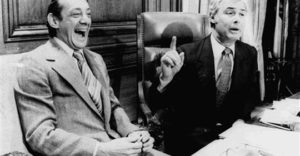
George Moscone was San Francisco’s very popular new mayor, after many years of Joe Alioto. Diane Feinstein was on the board of Supervisors, as was ex-police-chief Richard Hongisto, along with Harvey Milk and Dan White.

Harvey Milk ran a camera store on Castro street. He was the first openly gay candidate elected to public office when he was voted a Supervisor.

Dan White ran a tourist shop on Pier 39, and after being voted a Supervisor, supported the Briggs initiative, which would ban gays from teaching. Dan clashed with Harvey, and with mayor Moscone, on a number of issues, and Dan was also having business problems with his shop. White at one point resigned his post, and then later, wanted it back, but mayor Moscone declined.

According to White, his colleague Harvey Milk “smirked” at him, and therefore Dan White decided to kill both supervisor Milk and mayor Moscone with a small-caliber pistol.

Harvey Milk, the Gay Supervisor

He smuggled the pistol past City Hall security by the simple expedient of leaving a window open, through which he then re-entered with the pistol. He murdered both men in their offices with the hit-man’s trick: he shot them in the belly, which is so painful it incapacitates the man, and then close-up he shot them in the head.

Later, when White’s attorney invented the “Twinkie” defence, claiming White was unstable due to stress and eating Twinkies, there were riots, but at sentencing time, White escaped the death penalty, though after parole he committed suicide, as is proper for Twinkie murderers.

On the day of the murders, dimly following the reports on the radio through my flu-muddled mind, it seemed surreal, shocking and unbelievable. But perhaps I am to be forgiven that what I remember most about the day was something else entirely.

My girlfriend Joanne had made for me a long nightshirt, of orange and brown stripes; it resembled those long African robes that some black men affected at that time. Sounds awful, but it was comfortable.

I was wearing only this long shirt when I tore myself from my sickbed, because I had to take out the trash. It had heaped up too much, becoming smelly, and it was bugging me. I only had to go a few steps down the hall, and behind the frosted glass door was the trash chute. Nobody would see me, barefoot in my night shirt. No problem.

Afterward, discovering that I’d locked myself out of my apartment was very disappointing.

Dim-witted, I thought over my options. I didn’t much like them. And I didn’t like the obvious answer, which was to climb the stairs to the roof and come down the fire escape to my apartment on the third floor.

On the roof in the early November afternoon, the sky was bright overcast, and the sea breeze brisk. In my thin night shirt, no undies, no socks, I was freezing. No help for it.

At the edge of the roof, I paused, woozy. No help for it, so I firmly grabbed the hand rail, turned facing the roof, and stepped over the edge of the building, feeling with my bare foot for the metal step below. Found it. So, step by step, I climbed down the two stories to my own window.

The chill wind turned gusty, blowing my night dress in bursts up around my waist. Being naked beneath, I hoped no neighbors were at their windows.

Up the block, two black women pushing perambulators appeared around the corner and were briskly walking toward me.

“Oh, great,” I muttered, hoping that they wouldn’t look up.

I had to focus, but the biting cold of the metal steps on my hands and bare feet helped. I was shivering uncontrollably, but forced myself to move slowly and carefully. My night shirt blew lewdly this way and that. I was chilled through when I reached the metal ledge outside my window.

The window was open an inch. I pulled it open wide. Clumsily I climbed in.

I could hear the women as they passed below, for one spoke to the other.

“Now that burgler,” she said, “. . . he bold!”

Categories // All, Looking Back, mind, News

Sweeping the Snow

03.13.2011 by bloggard // Leave a Comment

Seventeen Cars for the Rock Island!

St. Louis, Winter 1967: At the Carrie Street station are fourteen tracks, lined up beside the main tracks that run around town to the Southern Pacific, the Erie, and the other lines. A local company called the “Terminal Railroad” hauls cars on these main tracks, in a big circle around the city.

“Got seventeen Rocks!” the Terminal conductor says, walking into the concrete office where the bill clerk and I do our work. He hands a bundle of Bills of Lading wrapped round with a rubber band to the bill clerk, while outside Danny and the switchmen throw the switch levers sticking up from the tracks, so that the Terminal train, which has just passed our yard and is now stopped, can back up these seventeen cars for us, the Rock Island Line, into one of our fourteen tracks.

Unhitched, those seventeen cars sit while the Terminal locomotive powers the rest of their train around the bend and out of sight.

And then it began to snow.

I never knew exactly what Bill the bill clerk did, but he spent his time inside the concrete office. I’d spend my time standing outside in the cold while the cars rolled past, writing down the car numbers as fast as I could.

If I could write these numbers as the cars passed by, then I didn’t have to walk up and down the freezing tracks to write down the numbers. From my car numbers written down and in order, Bill the bill clerk prepared a list for Danny and the switchmen.

By analysing the Bills of Lading, Bill determined that some cars were going to Kansas City — the next stop beyond St. Louis on the Rock Island Line — and that some other cars were bound for Denver or Santa Fe or Oakland. It was my job then to carry Bill’s list across the yard to Danny the switch foreman, and Danny would figure how to move the cars around into the correct order, so that the last group dropped off at Kansas City, the next group in Denver, and so on.

An engineer would then hook the switch engine to the cars, and pull them all forward, and then push them back into this track, and that track, and this other track, because that’s how you sort railroad cars. Some cars were called “pigs” because their flat beds were to be loaded with truck trailers; it stood for “piggy-back”. Other cars were called “reefers” because they were insulated, with motors on top to keep the interior refrigerated; these would be filled with perishables like frozen orange juice, or lettuce. Some cars were “tankers”, and some were plain old boxcars.

During all this switching, the switchmen, under Danny’s direction, stood at the switches. A switch is a tall iron bar sticking up from the tracks; you push or pull on the switching bar so that a section of track moves a few inches, so as to guide the incoming cars into track number four or track number five.

While the switchmen sorted cars, I returned to my desk with a copy of the switching list Danny made up, and upon my desk into a big box containing slots, numbered the same as the tracks outside, I sorted the Bills of Lading into the same order as the switchmen were sorting the cars. These Bills of Lading, in order, would go to Kansas City with the cars.

You see how many guys it takes? You see how all the jobs are divided up? You’d think that, since Bill and I had periods of time with nothing to do, as did the switchmen, that we could double on each others’ jobs. But no!

The union has penalties for that behavior. All jobs are defined and regulated by the union. Only a switchman can throw a switch. Only a yard clerk (me) can write down the numbers and sort the bills. Our jobs were protected, see, and we paid our union dues to keep it that way.

The problem was that this particular Sunday it started snowing, and soon there was an inch of snow on the tracks and switchboxes.

Mind you, this doesn’t interfere with the switchbox at all. The switchbox is a foot-square metal box, containing the gears that move the track section. Remember, the long bar that operates the switchbox is sticking four feet up into the air above the switch box with its one inch of snow.

But according to union rules, the switchmen are not required to throw a switch which has snow upon it. Instead, the switchmen can retire to huddle around the coal stove in the switch shanty, to read newspapers, shoot the breeze, and generally do nothing for the same hourly pay.

As soon as somebody sweeps the snow off the switch — a matter of four or five seconds with an ordinary broom — then the switchmen have to go back to work, moving those pigs and reefers and tankers into place for their trip to Kansas City.

Now, the person whose job includes sweeping snow off a switch is a carman. The carmen work normal business hours in the shop down at the end of track three. That’s where they repair broken cars, replace wheels, adjust brakes, grease bearings, and such maintainance work.

On this Sunday afternoon, the carmen had all gone home.

It therefore fell to Bill the bill clerk to call a carman out to the job. Now, Bill knew that many of the carmen would turn the job down. In fact he was pretty sure that the first dozen on the list — a list arranged by seniority — would turn it down.

It would have saved time if Bill could have just called carman number twelve, but that’s not permitted, as the most senior guys must be offered the (overtime) job first. A number of hours were spent, with me and the switchmen sitting idle, and then with the Terminal railroad crew and their entire train sitting idle on the main track, just passing by but blocked by our now-immobile switch engine, which our engineer couldn’t move because the switch, which the switchmen weren’t required to throw, because there was snow on the switch.

During these hours only Bill was working, tracking down one and then another of the senior carmen so they could turn down the job, as was their right and privilege. Finally Bill reached the bottom of the list and James the carman said sure, I’ll be right out.

An hour later, when James hadn’t arrived, Bill called to discover that James had fallen back asleep, while our crews and hundreds of tons of merchandise sat immobile. James apologised and again claimed that he’d be right out.

An hour later, when James still hadn’t arrived, Bill suddenly swore aloud, and throwing his clipboard across the room, he threw on his coat, grabbed the broom, and stomped across the yard, where he swept the snow from the switch in three quick strokes. The switch crew came out of the shanty to stare at Bill. Bill glared at the lot of them.

“Now throw the damn switch!” he roared.

Muttering and swearing, the switchmen marched into the cold and back to work, and later that night, twelve hours late, our train departed for Kansas City.

James the carman never did show up, but he got one day’s pay anyway, because he’d been called out. Bill had a chit filed against him for “job endangerment.” And I gained a whole new way of looking at the union.

Categories // All, amazement, buddhism, Looking Back, zen

Thanksgiving Past … and Present

03.13.2011 by bloggard // Leave a Comment

A Present for Hazel

Norwich, Vermont, Thanksgiving Day, 1960: While they built their dream home in Hannover, New Hampshire, Adrienne and her parents lived across the Connecticut River, in Vermont. Their temporary home backed onto government lands, where her father took them hiking, but not during deer season.

In the paper, the farmer offered some hound dogs, because the hunters kept shooting at them. Whether hunters mistook the brown-colored dogs for deer, or whether they chose to shoot the dogs to prevent their chasing the deer, was uncertain.

Adrienne wanted both of the two dogs, but she could only have one so she chose the one and named her “Taffy”. All the way home in the Renault, Taffy bayed out the window. Surely Taffy missed her sister.

But once settled, Taffy took to her new home, her new family, and the vast woodlands to roam, behind the house.

Years before, in an older and larger Colonial home, Adrienne’s grandparents used to visit during the summers. Her grandmother helped her grow strawberries, and then they’d trudge to the road, to sell them at their neighbor’s fruit stand.

But the grandfather had passed away, and the grandmother found a cottage on a lake in Florida, and wintered there, away from the cold. And so it was that the grandmother always missed the birthday of her daughter, Adrienne’s mother Hazel, for Hazel had been born on Thanksgiving day.

That year the family was preparing for the double holiday, but they couldn’t find Taffy. They called for her in the late morning, but she didn’t show up. They called for her in the early afternoon.

Finally, late on Thanksgiving day, with afternoon shadows stretching across the lawn, Taffy drug herself into the yard. Miles away, in the woods, she’d been shot, but she had crawled the miles, so she could die at home. Adrienne was devastated.

The next day, word arrived that the grandmother had been found in her cottage. She, too, had died on Thanksgiving day. Adrienne was devastated again, and Hazel took to her bed as well, crying for their loss.

“Of course she died on Thanksgiving,” wept Hazel. “She knows my bad memory. This way, on my birthday, she knows I’ll remember.”

The next day, a package arrived in the mail, which had been sent by the grandmother. Inside they found Hazel’s wrapped birthday present, which was a bottle of perfume.

Its name was “Heaven Scent.”

Categories // All, Looking Back

Stephanie Barbacaine

03.13.2011 by bloggard // Leave a Comment

Shoes and Music. Music and Shoes.

Dallas, 1965: First it was in Denton. The girls, Paula and Pretty Patty, had a house near Paul Miner’s second house. I used to visit, and smoke, and draw pictures, and spent the night with Pretty Patty. One night I became convinced that a small sculpture might take wing, and fly around her apartment.

I don’t remember those days with perfect clarity.

But Stephanie showed up. Actually her name was Patricia W., but she called herself Stephanie Barbacaine, and perhaps it fit better. Billy Bucher warned me. Some friend of his had got messed up, he said, by this Stephanie.

She had this peculiar, repeating behavior.

If she had trouble with a guy, she’d go find his best friend, and she’d sleep with the friend. I have no clue why. But if I recall aright from those dim days, Billy’s best friend had trouble with Stephanie Barbacaine, and she was making a play for Billy.

As I recall, it didn’t work. Billy wasn’t interested, or shook free somehow. And somehow, I got selected as Billy’s friend. This entanglement with Stephanie Barbacaine caused some major upsets with Pretty Patty, my girlfriend.

Those were confusing days. I was working nights, schooling days, smoking a lot, carousing way too much, and things were breaking down for me.

I do not recall exactly how it happened, but after explosions and conflagrations, Pretty Patty had a new apartment in Dallas, set back on a deep lawn beneath huge trees on the boulevard across from Southern Methodist University. I was working night shift at the armored car company in Dallas, counting hundreds of thousands of dollars through the night. And somehow it became too much trouble to drive the Morgan back to my cool apartment in Denton, so I gave it up, moving in with Patty Cake.

For a few days it went well.

We smoked a bit, and went on a decopage kick, decorating coffee cans, making wacko greeting cards, and such. Then one afternoon, Stephanie Barbacaine showed up at the door, with my friend Lefevre in tow.

I cannot imagine what the woman said, to explain their presence, but she said something, and was invited in. Soon Lefevre drew me aside. “Who the hell is this woman?” he asked.

I answered, but in fact, I’m not sure I knew then or know now. She was merry enough, attractive, thin, stylish, with frizzy hair, round eyes and a mocking, urbane manner. She’d been raised in an orphanage to the north of Dallas. She’d told me of her first trip to downtown Dallas, with the other children, on a bus trip to see a movie.

“I’d got all dressed up,” she said, “and as I stepped down from that school bus onto the sidewalk outside the movie theatre, I thought everyone would be watching me, and thinking how nice she looks! I thought the sidewalks were filled with people who’d come downtown to see me. And I was so proud, because I was all dressed up. So I just held my head up, and stepped down from that bus, and marched very prettily into the theatre.”

She’d once had a job modelling shoes, and I’d heard her describe herself as “a model.” She was pretty enough to be a model, I suppose, and she had a lot of shoes. She dressed more “grown-up” than most women, and she knew how to captivate a man, that’s for sure. She was a woman careening through life, inventing herself from whole cloth daily.

She and Lefevre spent the night, sleeping upon a pallet on the floor, which was kind of awkward, especially in the middle of the night, due to various noises. So, after Lefevre departed back to Wichita Falls, it’s not too surprising that Pretty Patty blew up one last time, saying she just couldn’t put up with it. And somehow I found myself living with Stephanie Barbacaine, in a white apartment on the fourth floor of an Art Deco building in the north of town.

It was at this time that I began to go nutty, spending countless hours trying to work out a budget. Now, budgeting is certainly a wise thing to do, but not the way I did it.

I was trying to calculate exactly how much I’d need, and so was dividing the cost of a movie over thirty days in the month, and creating elaborate calculations that had to be revised almost moment to moment. I wasn’t sleeping much at all. We went to a movie — Karen Black in “Lord Love a Duck” — and, walking out, I couldn’t remember much of anything about the movie we’d just seen.

Stephanie Barbacaine had a funny way about her, too. We were getting ready to go somewhere. A movie, the grocery store, dinner, I don’t recall, but I remember her sitting at her dressing table, with the lights all around the mirror, and doing her makeup. I was antsy to go, and kept nudging her.

Finally she said, “I’m a girl. I have makeup. I’m not a boy.” Which shut me up suddenly. After a while of silence, she said, “You’re worried that maybe you’re gay, right?”

Well, that hadn’t been in my mind, but it sure gave me something to think about. And life around her was like that. My mind was everywhere, and generally going to hell with the speed of an arrow. Somewhere along the line I moved out. I got a room in a boarding house, but stayed there only one night because it was too wierd.

I found a tiny apartment on my own but flipped out trying to cook spaghetti. The directions just seemed too complicated. The tiniest things in life were speeding up. So fast, so fast.

I made a blunder. There was an accident. I found myself in a hospital. That night, on the phone with Stephanie Barbacaine, she told me what she was wearing, and what was underneath all that; it was one of those calls. One thing led to another, and further adventures ensued, up and down, but somehow, somewhere in this smoke and confusion, with a sound like clanging bells I lost track of Stephanie Barbacaine.

Gone.

Categories // Looking Back

  • « Previous Page
  • 1
  • …
  • 36
  • 37
  • 38
  • 39
  • 40
  • …
  • 76
  • Next Page »

Your Fortune Cookie

  • Gifts count for nothing; will alone is great. -- Ella Wilcox

Our Host


Perhaps you are wondering why I have gathered all of you here.

Recent Posts

  • Join Me on Social Media …
  • Mister Blue
  • How to Drop the Weight, Look Better, and Feel Better … Made Easier
  • Most-efficient Exercise for Strength, Longevity, Blood-Pressure, and Balance

Recent Comments

  • bloggard on The Altar Boys
  • Tonja Scheer on The Altar Boys
  • Raymond J.Reiss on Calling Lonesome Cowboy Tim

Search By Keyword

Currently 603 micro-stories searchable online. Enter search words and hit return:

Search by Category

View My LinkedIn Profile

View Arthur Cronos's profile on LinkedIn

Credits and Copyright

All contents copyright (c) 2001-2026 Arthur Cronos and Voltos Industries, Mount Shasta, California. Reproduction prohibited except as noted. All rights reserved.

Webdesign by VOLTOS

** TEXT NAVIGATION **
Home * Archives * About the Bloggard * Bloggard's Concise Autoblography * Contact Us * Terms of Use * Privacy Policy * Site Map * Voltos Industries


reviews

[wprevpro_usetemplate tid=”1″]

All Contents Copyright © 2001-2019 · Webdesign by VOLTOS