The Adventures of Bloggard

Been Around the Block. Got Some Stories. These are Them.

  • Home
  • Archives
  • About Bloggard
  • Concise Autoblography
  • Contact

Thanksgiving Past … and Present

03.13.2011 by bloggard // Leave a Comment

A Present for Hazel

Norwich, Vermont, Thanksgiving Day, 1960: While they built their dream home in Hannover, New Hampshire, Adrienne and her parents lived across the Connecticut River, in Vermont. Their temporary home backed onto government lands, where her father took them hiking, but not during deer season.

In the paper, the farmer offered some hound dogs, because the hunters kept shooting at them. Whether hunters mistook the brown-colored dogs for deer, or whether they chose to shoot the dogs to prevent their chasing the deer, was uncertain.

Adrienne wanted both of the two dogs, but she could only have one so she chose the one and named her “Taffy”. All the way home in the Renault, Taffy bayed out the window. Surely Taffy missed her sister.

But once settled, Taffy took to her new home, her new family, and the vast woodlands to roam, behind the house.

Years before, in an older and larger Colonial home, Adrienne’s grandparents used to visit during the summers. Her grandmother helped her grow strawberries, and then they’d trudge to the road, to sell them at their neighbor’s fruit stand.

But the grandfather had passed away, and the grandmother found a cottage on a lake in Florida, and wintered there, away from the cold. And so it was that the grandmother always missed the birthday of her daughter, Adrienne’s mother Hazel, for Hazel had been born on Thanksgiving day.

That year the family was preparing for the double holiday, but they couldn’t find Taffy. They called for her in the late morning, but she didn’t show up. They called for her in the early afternoon.

Finally, late on Thanksgiving day, with afternoon shadows stretching across the lawn, Taffy drug herself into the yard. Miles away, in the woods, she’d been shot, but she had crawled the miles, so she could die at home. Adrienne was devastated.

The next day, word arrived that the grandmother had been found in her cottage. She, too, had died on Thanksgiving day. Adrienne was devastated again, and Hazel took to her bed as well, crying for their loss.

“Of course she died on Thanksgiving,” wept Hazel. “She knows my bad memory. This way, on my birthday, she knows I’ll remember.”

The next day, a package arrived in the mail, which had been sent by the grandmother. Inside they found Hazel’s wrapped birthday present, which was a bottle of perfume.

Its name was “Heaven Scent.”

Categories // All, Looking Back

But That’s My Side!

03.13.2011 by bloggard // Leave a Comment

Mercy Medical Center, Mount Shasta: Adrienne is recovering from the Komodo Kitty bite, or rather she’s recovering from the vile and pernicious bacterial infection, which, untreated, would have made her a dead person by today. It’s been pretty hard on her.

For one thing, Dr. Miller has installed tiny tubes inside her fingers which drip gorilla-cillin down into the infection, and she has these two valves which must be reset every hour. Drip on one tube, then drip on the other tube, then drip on the last tube.

Even on a Serta-brand mattress, waking once hourly for carburator adjustments does not make for a good night’s sleep.

And the lack of sleep is taking its toll.

Towards morning today, exhausted, life was looking pretty bleak. “I’m going to die, aren’t I?” she asked me.

I told her I didn’t think she would die, because in fact the hand is on the mend. I think it’s the wipeout from the powerful antibiotics and the lack of sleep that make her feel grim.

She’s also oppressed because she’s had about all she can take of being wrapped in plastic tubes, machines that beep, blood being taken, stinging veins, gastric turmoil, no appetite, and she can’t get her hair washed.

She just feels like she can’t take any more. And to make matters worse, we heard yesterday that Kaiser, from whom we have our insurance, was making arrangements to haul her in an ambulance down to San Rafael, for further tests, and another long hospital stint far away.

I have implored Dr. Miller and Dr. Gunda to persuade Kaiser to forswear this trip, if possible, but they’re warning her to prepare to travel. A large packet of copies of her x-rays was sitting on the bed. Gloom prevailed.

She was apologising for, as she described it, coming apart. I tried to reassure her that it was mainly the fatigue making her feel so overwhelmed, and I remembered something that happened to a buddy of mine.

His name was Tom and he ran an answering service near Ventura some years ago. He got smart and sold the business and bought a Grand Banks, which is a large and fancy powerboat, and last I heard he’d sailed off to adventures. If the Pirates of the Carribean didn’t get him, for all I know he’s sailing still.

But this story was back when he was an air-force pilot. As part of their training, they had to learn to survive, with nothing but half-rations and one sleeping bag, behind enemy lines. So to help them learn, they’d be dropped, pilot and co-pilot, way out in the boondocks, and they had to make it through the miles and the cold, and all without being spotted.

His co-pilot was a rugged fellow named Jim, and they made good time the first day, slept fairly well in some found shelter that night, and the next day got pretty lost and it turned nasty cold. After a long, a hungry, and an exhausting day, they’d finally rigged a lean-to for shelter, and there was no help for it but they’d need to sleep together for body heat.

Tom crawled into the shelter, into the sleeping bag. “Come on,” he said.

Jim paused. Tom lost patience.

“Come on, dammit!” Tom said, “We’ve got to rest.” Jim paused. He swayed. Tears ran from Jim’s eyes.

“But, but,” he said, “But that’s my side!”

. . .

I am delighted to report that the nurse just announced that reason has prevailed. Assuming no last-minute complications, Adrienne need not be hauled to Kaiser. Adrienne will be released tomorrow.

I kissed the nurse.

And Adrienne’s daughter Celina just arrived, to wash her hair.

Categories // Looking Back

A Moment in Time

03.13.2011 by bloggard // Leave a Comment

Wichita Falls, 1961: I was the head of the drum section, and in my senior year of high school I was voted “Band King”, and had a large picture in our yearbook, The Bearcat. Last summer, I’d spent two weeks at a drumming camp in Arlington, Texas, led by two older guys and Emmory Whipple, who was three times state Rudimental Champion.

The military style of playing a snare drum, very crisply, is called “Rudimental” drumming, because there are 26 drum rudiments. They have fanciful names, such as five-stroke roll, double paradiddle, flamaque. Combined, you can play any rhythmic pattern that can be written.

Playing the rudiments cleanly and quickly came easily to me. I encountered a space where I was just looking at the music, hearing in my mind what it should sound like, and my hands creating that sound. All the while, I sat back, like an engineer in a control booth, adjusting this, regulating that.

I was pretty good. That’s why it was so upsetting.

For the regional try-outs, I’d chosen a drum solo called “The Downfall of Paris“. As my name was French, perhaps I should have paid more attention to the omen. But I liked the song. I can still hear it, in my head, echoing down the corridors all these decades since, the stacatto cadences of the Downfall of Paris.

And I can remember the rain. But I’m getting ahead of myself.

I halfway thought, hoped, and feared that I would go to State. It was possible. Our band director, Mr. Raeke, didn’t say much, but he seemed to think it possible, too. I admired Mr. Raeke. He was cool, meaning he dressed neatly, wore a crew cut, had clean features, smoked, was quiet with a cynical sense of humor. A bit like Peter Gunn, except he never beat people up, being the band director rather than a private eye.

I’d practiced and practiced. I knew the solo backwards and forwards. The contest was in Wichita Falls, a big city near our town. The day was rainy as we drove to the contest, a gray day. And as I stood in the hallway, outside the room where the drumming judge would score me, I felt both confident and very nervous.

Finally it was my turn.

I went inside. There were a few steps down, and a music stand, and a thin fellow with wiry hair. I placed my music on the music stand, and adjusted the snares on the bottom of the drum. I was ready.

“The Downfall of Paris,” I said. I began to play. And in the ninth measure, right on the Flamaque, the very tip of my left stick, descending, caught the tip of my right stick, rising, and I’d made a mistake.

It threw me. I should have continued, but I’d stopped.

I began again.

Oh! At the exact same place, the exact same thing happened.

I stopped. The judge looked at me expectantly, but I didn’t begin again. The contest was already lost. I’d not be going further. I’d not be going to the state contest.

The judge, perhaps attempting to be kind, told me some information, which was in fact wrong. He told me that the seven-stroke roll should always be started with the left hand. Of course, that’s one school of thought. But I’d already mastered the other school. I could do the roll perfectly starting with either hand.

But not today. Today my head was burning, the contest was lost, and a confusion roared in my ears as I tried to listen politely.

And then I left.

I stood on the porch of the building, just out of the rain, smoking cigarettes, and thinking darkly of self pity. Mr. Raeke came to the door, looked out. He saw my face, and I guess that told him how the contest had gone. He said nothing, but went back inside.

Some time later, we drove back to our town. I didn’t talk much. As it turned out, I gave up drumming not long afterward, and never did it again. On the drive back, I didn’t say much because I knew that a corner had turned, that my life had changed.

And that I was a different fellow, going home. And I didn’t know who.

Categories // Looking Back

Sweeping the Snow

03.13.2011 by bloggard // Leave a Comment

Seventeen Cars for the Rock Island!

St. Louis, Winter 1967: At the Carrie Street station are fourteen tracks, lined up beside the main tracks that run around town to the Southern Pacific, the Erie, and the other lines. A local company called the “Terminal Railroad” hauls cars on these main tracks, in a big circle around the city.

“Got seventeen Rocks!” the Terminal conductor says, walking into the concrete office where the bill clerk and I do our work. He hands a bundle of Bills of Lading wrapped round with a rubber band to the bill clerk, while outside Danny and the switchmen throw the switch levers sticking up from the tracks, so that the Terminal train, which has just passed our yard and is now stopped, can back up these seventeen cars for us, the Rock Island Line, into one of our fourteen tracks.

Unhitched, those seventeen cars sit while the Terminal locomotive powers the rest of their train around the bend and out of sight.

And then it began to snow.

I never knew exactly what Bill the bill clerk did, but he spent his time inside the concrete office. I’d spend my time standing outside in the cold while the cars rolled past, writing down the car numbers as fast as I could.

If I could write these numbers as the cars passed by, then I didn’t have to walk up and down the freezing tracks to write down the numbers. From my car numbers written down and in order, Bill the bill clerk prepared a list for Danny and the switchmen.

By analysing the Bills of Lading, Bill determined that some cars were going to Kansas City — the next stop beyond St. Louis on the Rock Island Line — and that some other cars were bound for Denver or Santa Fe or Oakland. It was my job then to carry Bill’s list across the yard to Danny the switch foreman, and Danny would figure how to move the cars around into the correct order, so that the last group dropped off at Kansas City, the next group in Denver, and so on.

An engineer would then hook the switch engine to the cars, and pull them all forward, and then push them back into this track, and that track, and this other track, because that’s how you sort railroad cars. Some cars were called “pigs” because their flat beds were to be loaded with truck trailers; it stood for “piggy-back”. Other cars were called “reefers” because they were insulated, with motors on top to keep the interior refrigerated; these would be filled with perishables like frozen orange juice, or lettuce. Some cars were “tankers”, and some were plain old boxcars.

During all this switching, the switchmen, under Danny’s direction, stood at the switches. A switch is a tall iron bar sticking up from the tracks; you push or pull on the switching bar so that a section of track moves a few inches, so as to guide the incoming cars into track number four or track number five.

While the switchmen sorted cars, I returned to my desk with a copy of the switching list Danny made up, and upon my desk into a big box containing slots, numbered the same as the tracks outside, I sorted the Bills of Lading into the same order as the switchmen were sorting the cars. These Bills of Lading, in order, would go to Kansas City with the cars.

You see how many guys it takes? You see how all the jobs are divided up? You’d think that, since Bill and I had periods of time with nothing to do, as did the switchmen, that we could double on each others’ jobs. But no!

The union has penalties for that behavior. All jobs are defined and regulated by the union. Only a switchman can throw a switch. Only a yard clerk (me) can write down the numbers and sort the bills. Our jobs were protected, see, and we paid our union dues to keep it that way.

The problem was that this particular Sunday it started snowing, and soon there was an inch of snow on the tracks and switchboxes.

Mind you, this doesn’t interfere with the switchbox at all. The switchbox is a foot-square metal box, containing the gears that move the track section. Remember, the long bar that operates the switchbox is sticking four feet up into the air above the switch box with its one inch of snow.

But according to union rules, the switchmen are not required to throw a switch which has snow upon it. Instead, the switchmen can retire to huddle around the coal stove in the switch shanty, to read newspapers, shoot the breeze, and generally do nothing for the same hourly pay.

As soon as somebody sweeps the snow off the switch — a matter of four or five seconds with an ordinary broom — then the switchmen have to go back to work, moving those pigs and reefers and tankers into place for their trip to Kansas City.

Now, the person whose job includes sweeping snow off a switch is a carman. The carmen work normal business hours in the shop down at the end of track three. That’s where they repair broken cars, replace wheels, adjust brakes, grease bearings, and such maintainance work.

On this Sunday afternoon, the carmen had all gone home.

It therefore fell to Bill the bill clerk to call a carman out to the job. Now, Bill knew that many of the carmen would turn the job down. In fact he was pretty sure that the first dozen on the list — a list arranged by seniority — would turn it down.

It would have saved time if Bill could have just called carman number twelve, but that’s not permitted, as the most senior guys must be offered the (overtime) job first. A number of hours were spent, with me and the switchmen sitting idle, and then with the Terminal railroad crew and their entire train sitting idle on the main track, just passing by but blocked by our now-immobile switch engine, which our engineer couldn’t move because the switch, which the switchmen weren’t required to throw, because there was snow on the switch.

During these hours only Bill was working, tracking down one and then another of the senior carmen so they could turn down the job, as was their right and privilege. Finally Bill reached the bottom of the list and James the carman said sure, I’ll be right out.

An hour later, when James hadn’t arrived, Bill called to discover that James had fallen back asleep, while our crews and hundreds of tons of merchandise sat immobile. James apologised and again claimed that he’d be right out.

An hour later, when James still hadn’t arrived, Bill suddenly swore aloud, and throwing his clipboard across the room, he threw on his coat, grabbed the broom, and stomped across the yard, where he swept the snow from the switch in three quick strokes. The switch crew came out of the shanty to stare at Bill. Bill glared at the lot of them.

“Now throw the damn switch!” he roared.

Muttering and swearing, the switchmen marched into the cold and back to work, and later that night, twelve hours late, our train departed for Kansas City.

James the carman never did show up, but he got one day’s pay anyway, because he’d been called out. Bill had a chit filed against him for “job endangerment.” And I gained a whole new way of looking at the union.

Categories // All, amazement, buddhism, Looking Back, zen

Dead Man Boots

03.13.2011 by bloggard // Leave a Comment

January 3, 2004, Mount Shasta: We’ve had storms of snow, swirling thickly, white-out visibility, and heaps on the ground up to my waist.

I’ve never seen such snow before. Growing up in Texas, some winters we’d see snow. A really heavy snow might be four or five inches. It would linger a few days, growing muddy and fading away.

A new year’s resolution is to exercise more. I’ve really been in luck on that one.

I’ve never shoveled snow before. Driving a trail from the back door to the office, to the gate, to the car, and then clearing the five-foot berm thrown up by the town’s snow plow.

Let’s just say I’m off to a good start on my exercise.

Because of the speed with which we moved, and the jumble of things to be done, some things weren’t. We didn’t get boots. We didn’t get snow tires.

Adrienne’s daughters Celina and Layla came a-visiting for Christmas, just in time to help visit Adrienne in hospital. Layla got out of town eight hours before the storm, but Celina and family were trapped at Econo-Lodge. The innkeeper graciously permitted them to stay over, at triple the rate.

They bought chains so as to escape down the mountain.

I couldn’t get chains and got something called “cables”, like chains but smaller and easier to put on. But on our new Ford Focus, with it’s front-wheel drive, they’ve been altogether marvy. Just drive along like anything.

That is, after an hour or two of uncovering the car from several feet of snow. Several days in a row. Actually, I kind of like shoveling the snow. Makes me pant, and the air is fresh and cold. My shoes were a problem; they wouldn’t do for this deep snow.

My friend Harvey, now gone, left a pair of boots. Somehow they came to me. Cowboy boots, with snake skin. I’m wearing them now, in the snow.

Me and Harvey, shoveling snow, my toes growing numb inside his boots. Ghosts and a fog of breathing, in the cold air.

Categories // Looking Back

So Long — Adieu Kangaroo

03.13.2011 by bloggard // Leave a Comment

The Captain bites on Mr. Moose's Knock-Knock Joke, again.

Montpelier, Vermont: Bob Keeshan, Captain Kangaroo on television, died at 76. The show, consisting of visits with puppets like Mr. Moose telling knock-knock jokes (shown here), won several awards and was wildly popular with children. As a young man, I kind of liked him, too. Just a throw-back, I suppose.

The Captain did the same thing every day. Sporting a Beatles haircut and large moustache, and wearing what appeared to be an English bus-driver’s uniform whose huge pockets were filled with unexpected objects, he puttered around in the “Treasure House”, chatting with the puppets and Mr. Green Jeans, an eternally unemployed neighbor.

It strikes me now that Captain Kangaroo was very lucky to have Mr. Green Jeans as a neighbor, because most folks wouldn’t be able to visit every single day like that.

Once the Captain was selling something, some kind of “Fun Kit”, consisting of scissors and glue and crayons, and my little brother George wanted one.

Christmas was fast approaching, and that gave me an idea.

In my low teens, and eternally short on cash due to having spent it, I realized that I could make a Fun Kit for George. It would have all the right stuff inside, because the Captain had spelled it out on TV.

I found a box and decorated it. In the box I put scissors, glue, crayons, and some other things as were proper. I wrapped it up and waited. That Christmas was spent at my grandmother’s house, and it was there that George opened his present. He scowled.

“That’s not a Fun Kit,” he said.

Bummer.

I sulked and sulked, but all was not lost, as it turned out, because George had an insistant habit of shaking Christmas presents, trying to puzzle them out by sound.

And therefore, to enhance the Fun Kit, I’d found a burned-out light bulb, and packing the Fun Kit tightly so it would make no sound, I had included the lightbulb near the surface. As expected, right up until Christmas day, George had shaken the package every day, but it only made the small tinkling sound that you’d expect from a burned-out light bulb. “What is it?” George had asked, again and again, “What is it?“

I would smile and say that it was a light bulb.

“No, no!” he’d cry, “What is it?” And it turned out that, although the Fun Kit was a dismal flop, the light bulb became a great hit in our family, and we gave each other light bulbs at Christmas-time for many years to come.

So I guess I owe you after all, Captain Kangaroo. Thanks for the light bulbs.

…

An ex-marine, the Captain first appeared on TV as Clarabell the Clown on Howdy Doody. Along with (now deceased) Mister Rogers, the Captain deplored the modern direction of TV for children, citing violence and vengeance as extreme and unhealthy. Even though I like fight-em-up movies, I’d have to agree with the Captain.

“Play is the work of children,” he said, “It’s very serious stuff. And if it’s properly structured in a developmental program, children can blossom.”

His wife had died in 1990. Probably he missed her. Perhaps he’s seeing her again. Perhaps he is peaceful.

Categories // Looking Back

The Day of the Murders

03.13.2011 by bloggard // 2 Comments

San Francisco, November 27, 1978: I was living in the studio apartment at 495 Third Avenue; and I had a devastating flu that knocked me woozy, half-unconscious.

Over the radio, the murders seemed lurid, wacko, surreal.

George Moscone was San Francisco’s very popular new mayor, after many years of Joe Alioto. Diane Feinstein was on the board of Supervisors, as was ex-police-chief Richard Hongisto, along with Harvey Milk and Dan White.

Harvey Milk ran a camera store on Castro street. He was the first openly gay candidate elected to public office when he was voted a Supervisor.

Dan White ran a tourist shop on Pier 39, and after being voted a Supervisor, supported the Briggs initiative, which would ban gays from teaching. Dan clashed with Harvey, and with mayor Moscone, on a number of issues, and Dan was also having business problems with his shop. White at one point resigned his post, and then later, wanted it back, but mayor Moscone declined.

According to White, his colleague Harvey Milk “smirked” at him, and therefore Dan White decided to kill both supervisor Milk and mayor Moscone with a small-caliber pistol.

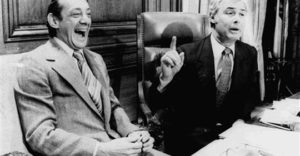
Harvey Milk, the Gay Supervisor

He smuggled the pistol past City Hall security by the simple expedient of leaving a window open, through which he then re-entered with the pistol. He murdered both men in their offices with the hit-man’s trick: he shot them in the belly, which is so painful it incapacitates the man, and then close-up he shot them in the head.

Later, when White’s attorney invented the “Twinkie” defence, claiming White was unstable due to stress and eating Twinkies, there were riots, but at sentencing time, White escaped the death penalty, though after parole he committed suicide, as is proper for Twinkie murderers.

On the day of the murders, dimly following the reports on the radio through my flu-muddled mind, it seemed surreal, shocking and unbelievable. But perhaps I am to be forgiven that what I remember most about the day was something else entirely.

My girlfriend Joanne had made for me a long nightshirt, of orange and brown stripes; it resembled those long African robes that some black men affected at that time. Sounds awful, but it was comfortable.

I was wearing only this long shirt when I tore myself from my sickbed, because I had to take out the trash. It had heaped up too much, becoming smelly, and it was bugging me. I only had to go a few steps down the hall, and behind the frosted glass door was the trash chute. Nobody would see me, barefoot in my night shirt. No problem.

Afterward, discovering that I’d locked myself out of my apartment was very disappointing.

Dim-witted, I thought over my options. I didn’t much like them. And I didn’t like the obvious answer, which was to climb the stairs to the roof and come down the fire escape to my apartment on the third floor.

On the roof in the early November afternoon, the sky was bright overcast, and the sea breeze brisk. In my thin night shirt, no undies, no socks, I was freezing. No help for it.

At the edge of the roof, I paused, woozy. No help for it, so I firmly grabbed the hand rail, turned facing the roof, and stepped over the edge of the building, feeling with my bare foot for the metal step below. Found it. So, step by step, I climbed down the two stories to my own window.

The chill wind turned gusty, blowing my night dress in bursts up around my waist. Being naked beneath, I hoped no neighbors were at their windows.

Up the block, two black women pushing perambulators appeared around the corner and were briskly walking toward me.

“Oh, great,” I muttered, hoping that they wouldn’t look up.

I had to focus, but the biting cold of the metal steps on my hands and bare feet helped. I was shivering uncontrollably, but forced myself to move slowly and carefully. My night shirt blew lewdly this way and that. I was chilled through when I reached the metal ledge outside my window.

The window was open an inch. I pulled it open wide. Clumsily I climbed in.

I could hear the women as they passed below, for one spoke to the other.

“Now that burgler,” she said, “. . . he bold!”

Categories // All, Looking Back, mind, News

Very Strong Auditor

03.13.2011 by bloggard // Leave a Comment

Westbury Hotel, San Francisco, 1974: When my mother lost money in the stock market, it became difficult for her to continue sending funds for San Francisco State.

Fine with me. I’d found the courses in Creative Writing both helped and interfered with my writing, so I dropped out, found the Apartment from Hell, and located a job as part-time night auditor at the Westbury Hotel, downtown just off Union Square.

Thirty stories of steel and glass above us, and in the lobby late at night I’d think, “What if the earthquake comes now?”

Showing me the audit, was the regular night auditor, Henry So.

He had a peculiar habit.

Realize that the night auditor works at the front desk. In all but the largest hotels, he’s the cashier who takes your money when you check out early in the morning before 7 am.

And what he does all night is to put the charges for the rooms on all the bills, and then to balance all the charges for guest accounts from the day. That is, the restaurant on the 30th floor has sent down the checks that guests signed, and those go on the bill. Perhaps the guest has sent clothing out for laundry, or for dry-cleaning which is for some reason called valet. Or perhaps the guest has charges from the one bar or the other bar, or from the coffee shop.

Each of these departments, for example the “laundry” department, sends their records to the front desk. The night auditor makes sure that the amount that housekeeping thinks was charged to “laundry” was really and truly charged to the guest accounts as laundry.

After that’s done, and the last bar is closed, then the night auditor makes sure that the total of charges on all the guest accounts equal the total of charges made today plus the amount that they owed us from yesterday.

If anything doesn’t balance, you figure out what it is and fix it. A proud night auditor will generally brag that he balances to the penny. I generally did. So did So, that is, so did Henry So, the regular night auditor.

He was fron Hong Kong, thin and angular, taciturn, always wearing a charcoal suit with vest, smoked Bensen & Hedges cigarettes which he considered a sign of great sophistication, and lit them with a gold Dunhill lighter from his vest pocket.

After he had balanced the night’s books, the last chore is to bundle up the long printed paper tape from the bookkeeping machine, which is a glorified cash register. Most auditors roll it up and snap a rubber band around it, but Henry So had a special routine.

Once the books were balanced, and only the tape was left, he’d pull a stool up to the counter, get his ashtray and light a Benson & Hedges with his Dunhill lighter. Then he’d set the cigarette in the ashtray and patiently he would fold the tape.

He’d make the first fold perhaps eight inches long, then the next fold exactly the same, and then each subsequent fold was lined up precisely with the last, so that when he was through, the tape looked as if folded by a machine.

I asked him about his background. I asked him why he folded the tape like that. Here’s what he told me:

“I learn night audit in Hong Kong,” he said. “Everyone speak English and French. I got to school, and I am very strong student. I say I am going to be night auditor, and so when I get job, first job, for two weeks only all I am allowed to do is fold tape.” He paused. I nodded.

“My teacher,” he continued, “he very strong night auditor. I wish to be strong night auditor. He say I must learn night audit just right. He say when I can fold tape, then I can learn night audit. So two week, all I do is fold tape. First night, I fold tape all any way, like you. He say I cannot be strong night auditor if I fold tape like you. So I fold tape. I fold tape just so. Finally, he teach me night auditor. Now I am strong night auditor.”

I asked him whether they used the same machine in Hong Kong as we did, in this case an NCR bookkeeping machine, model 4200. He said they did. He said he would like to work at Sir Francis Drake but that they used confuter. “I can not work Sir Francis Drake,” he said. “I don’t know confuter.”

Once I had learned the audit, since I was only the replacement night auditor, on two other nights I filled in as front desk clerk on the same shift, and so I worked those nights with Henry So.

We took turns taking breaks in Zim’s restaurant, the coffee shop in the corner of the lobby, where a repeating crew of regulars assembled every night. There was a lucid and intelligent fellow who held forth every night on politics and current events, and the regular waitresses, Henry, myself, Lonesome Chuck or Mr. Slocum the security guys, Earnest the janitor, and another handful of night-time eccentrics.

One was a woman who had no actual home. She spent every night in the Zims, and during the days she went to the Main Library, and spent the days there. (We know because one of our crew followed her one day to see where she went.)

It was on that night shift that I launched my bookkeeping business. Then I left the night audit to run the postering company, and then the answering service, and my road led to other adventures, and then one day in my boots and motorcycle helmet, I was walking across the street beside the Westbury, and was surprised to find Henry So, in his charcoal suit with vest, walking beside me.

“Hello!” I cried out. He was surprised as well, and we stood on the far corner, blocking pedestrians and catching up on our news of the last few years.

“I’ll never forget,” I said, preparing to leave, “I’ll never forget how you used to fold that tape, and how you told me how your teacher made you fold it for two weeks before he would show you the night audit.”

Henry So stared at me blankly. “What?” he said.

I told him again, how I remembered the way he folded the tape and how his teacher in the first hotel in Hong Kong had insisted that he fold the tape just so for two weeks.

Henry’s face cracked a big grin. “I told you that?” he asked.

I said yes.

Standing on the corner in his charcoal suit and vest, he laughed and laughed and laughed.

Categories // Looking Back

  • « Previous Page
  • 1
  • …
  • 25
  • 26
  • 27
  • 28
  • 29
  • …
  • 55
  • Next Page »

Your Fortune Cookie

  • From a larger perspective, your whole life is sudden-death overtime ... and the clock is ticking.

Our Host


Perhaps you are wondering why I have gathered all of you here.

Recent Posts

  • Mister Blue
  • Join Me on Social Media …
  • How to Drop the Weight, Look Better, and Feel Better … Made Easier
  • Most-efficient Exercise for Strength, Longevity, Blood-Pressure, and Balance

Recent Comments

  • bloggard on The Altar Boys
  • Tonja Scheer on The Altar Boys
  • Raymond J.Reiss on Calling Lonesome Cowboy Tim

Search By Keyword

Currently 603 micro-stories searchable online. Enter search words and hit return:

Search by Category

View My LinkedIn Profile

View Arthur Cronos's profile on LinkedIn

Credits and Copyright

All contents copyright (c) 2001-2026 Arthur Cronos and Voltos Industries, Mount Shasta, California. Reproduction prohibited except as noted. All rights reserved.

Webdesign by VOLTOS

** TEXT NAVIGATION **
Home * Archives * About the Bloggard * Bloggard's Concise Autoblography * Contact Us * Terms of Use * Privacy Policy * Site Map * Voltos Industries


reviews

[wprevpro_usetemplate tid=”1″]

All Contents Copyright © 2001-2019 · Webdesign by VOLTOS